Variable-duration behavior kernels
Experimental
This workflow estimates predictive trajectories for declared behavioral bouts. It does not validate the behavior classifier or make a bout effect causal.
Three distinct questions
For a variable-duration behavior such as rearing, grooming, or approach, keep these hypotheses separate:
- Onset or offset: is there a transient aligned to a physical edge?
- Duration modulation: does the edge response change per second of bout duration?
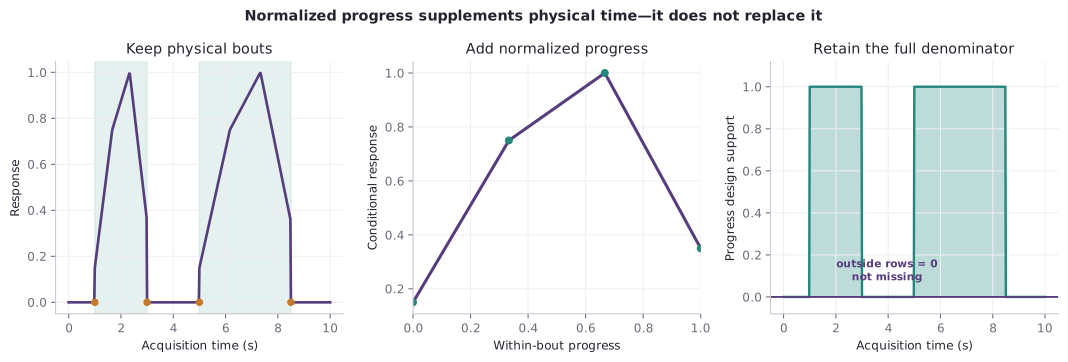
- Normalized progress: how does the conditional response vary from the start to the end of the active state?
Normalized progress supplements physical time. It does not turn a long and short bout into the same physical process.
Convert typed annotations without losing duration
Adapters for Keypoint-MoSeq and BORIS produce BehaviorAnnotations. Convert only
the intervals needed for encoding:
inputs = annotations.interval_encoding_inputs(edge="onset")

session = EncodingSession.from_arrays(
    subject=annotations.subject,
    session=annotations.session,
    time=photometry_time,
    response=corrected_signal,
    events=inputs.events,
    event_values=inputs.event_values,
    intervals=inputs.intervals,
)
The bundle keeps onset times and duration_s aligned one-for-one and retains every
physical (start_s, stop_s) pair. Choose edge="offset" explicitly when offset is
the scientific reference. The helper does not synchronize clocks: transform the
annotations to the photometry clock first and retain that synchronization evidence.
Declare edge, duration, and progress terms
from fiberphotometry import (
    EncodingModelSpec,
    EventKernelSpec,
    EventModulationSpec,
    LinearProgressBasisSpec,
    ProgressKernelSpec,
)

spec = EncodingModelSpec(
    event_kernels=(
        EventKernelSpec("rear", (-1.0, 2.0)),
        EventKernelSpec(
            "rear-by-duration",
            (-1.0, 2.0),
            source_event="rear",
            modulation=EventModulationSpec("duration_s"),
        ),
    ),
    progress_kernels=(
        ProgressKernelSpec(
            "rear-progress",
            source_interval="rear",
            basis=LinearProgressBasisSpec(functions=5),
        ),
    ),
    group_by="animal",
)
The unmodulated edge kernel is the response at zero duration under raw-second coding, which may be an extrapolated reference. For a more meaningful main effect, the caller can supply an explicitly centered duration value under another name. FiberPhotometry does not center event values after seeing outcomes.
How progress fitting works
Each acquired sample inside a bout is assigned (time - start) / (stop - start).
A piecewise-linear basis spans progress from zero to one. Outside-bout rows contain
zeros for every progress component and remain in the full-session denominator;
they are not marked missing or discarded.
The result reports:
- the physical source interval and total bout count;
- the reconstructed curve on a declared 101-point progress grid;
- basis functions and weights needed for exact reconstruction;
- delete-one-group sensitivity intervals on the progress grid; and
- the same group-held-out prediction and residual diagnostics as event kernels.
Within one modeled interval family, bounds must be ordered, non-overlapping, and
fully supported by the recording. Intervals use half-open sampling [start, stop)
so adjacent bouts do not double-count a boundary sample.
Treat alternatives as a multiverse
Onset-only, onset-plus-duration, and onset-plus-progress models answer different
questions. Compare them as named alternatives with run_encoding_multiverse().
Held-out score deltas are reported only on identical retained timestamps, and a
failed progress model stays in the ledger.
Run the complete simulation:
See SDR-0038 for the decision and the behavior-tool tutorial for DeepLabCut, SLEAP, Keypoint-MoSeq, and BORIS inputs.