Public dopamine-sensor transient validation: retained disagreement
The detector choice materially changes the result
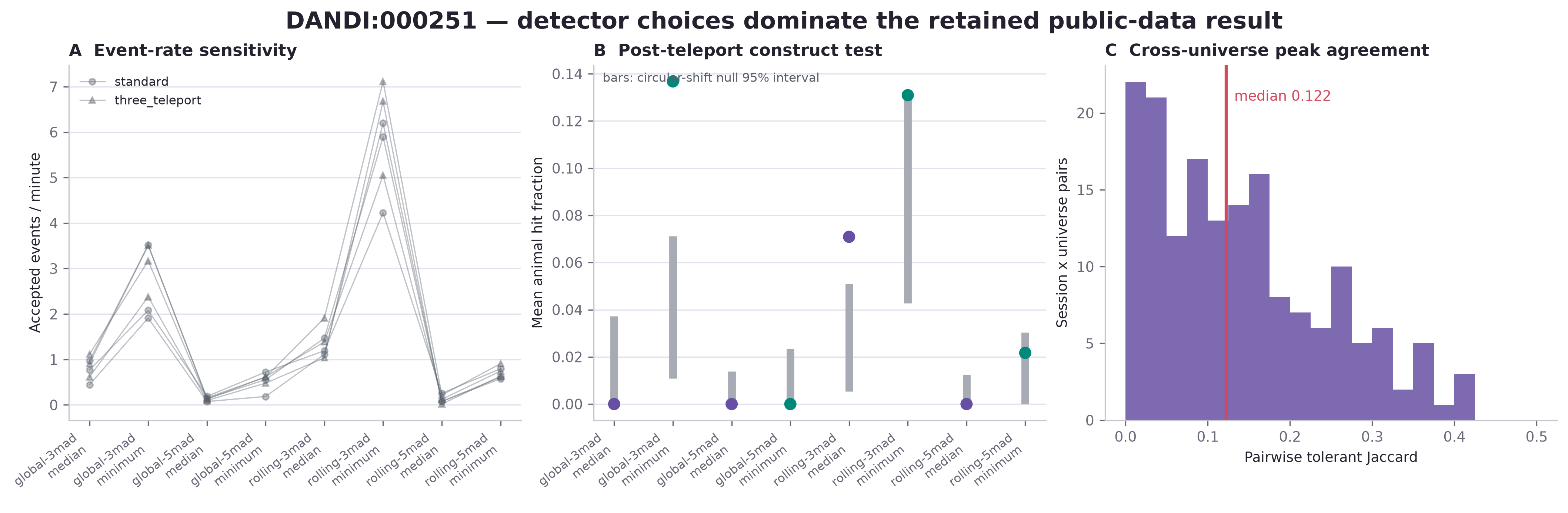
Across eight prospectively frozen universes, session event rates ranged from 0.019 to 7.115 events/minute and median pairwise peak-set agreement was only Jaccard 0.122. This result does not justify a universal default detector.
The question
We used six public ventral-striatal dLight sessions from three animals in DANDI:000251, associated with Kim et al.'s study of dopamine signals across timescales. Each animal contributed a standard virtual-reality session and a three-teleport session. The source paper quantified teleport-response peaks 0.6–2.1 s after teleport, giving us an external timing criterion that existed before this analysis.
The protocol, asset manifest, and all eight detector universes were frozen before outcomes were inspected.
What happened
Only three of eight universes showed post-teleport enrichment relative to the frozen circular-shift null:
| Universe | Mean animal hit fraction | Null mean | Upper-tail probability |
|---|---|---|---|
| global 3-MAD, minimum baseline | 0.137 | 0.038 | 0.001 |
| rolling 3-MAD, median baseline | 0.071 | 0.025 | 0.001 |
| rolling 3-MAD, minimum baseline | 0.131 | 0.084 | 0.023 |
The remaining five universes did not show enrichment. All 5-MAD universes failed the construct test, and animal 215 had zero teleport-window hits in every universe. This is not a clean detector-validation success.
The larger result is instability: the minimum pre-peak baseline admits many more events than the median baseline, and moving from 3 to 5 MAD often removes nearly all events. Pairwise tolerant Jaccard agreement ranged from 0 to 0.425. Researchers could therefore obtain qualitatively different event sets from superficially reasonable choices.
Interpretation
The result provides limited construct validity for permissive 3-MAD definitions, but the evidence is method- and animal-dependent. It supports the package's multiverse design: detector settings must be named, rejected candidates retained, and downstream claims tested across alternatives.
It does not establish biological ground truth. The archived signal is already dF/F, no raw reference channel is available, and task-locked enrichment does not validate peaks outside task windows as spontaneous dopamine-release episodes. It also does not identify a tonic component.
Reproduce
uv run --extra nwb python scripts/run_dandi_000251_transients.py
uv run --extra plots python scripts/plot_dandi_000251_transients.py
The committed result artifact contains all session/universe peak times, exclusion counts, event summaries, external-validation statistics, pairwise agreements, and a deterministic SHA-256.
Sources
- Kim et al., A unified framework for dopamine signals across timescales.
- Bruno et al., PASTa.
- Sherathiya et al., GuPPy.