DANDI 000971 end-to-end tutorial result v0.1
Status: completed descriptive product demonstration (27 July 2026)
What was executed
The prospectively frozen protocol
was committed as b004b8f before the selected fluorescence outcomes were accessed.
All six files from immutable DANDI:000971 version 0.260213.1851 matched their
frozen byte sizes and SHA-256 digests. No asset was replaced and no source,
schema, or event preflight failed.
The committed evidence bundle contains
the preflight, primary result, complete multiverse, self-contained HTML report,
and checksum manifest. The executable source remains
examples/dandi_000971_reward_tutorial.py.
Event denominator
| Animal | Published family | Active pokes | Rewarded | Unrewarded | Boundary exclusions |
|---|---|---|---|---|---|
| 028-392 | PR | 87 | 32 | 55 | 0 |
| 048-392 | PR | 124 | 25 | 99 | 0 |
| 272-396 | DPR | 149 | 39 | 110 | 0 |
| 333-393 | DPR | 246 | 49 | 197 | 0 |
| 112-283 | PS | 42 | 7 | 35 | 0 |
| 113-283 | PS | 311 | 48 | 263 | 0 |
The 959 events are observations, not 959 independent replicates. Every analysis first reduces them to within-animal rewarded and unrewarded summaries; six animal contrasts determine the inferential uncertainty. The large count imbalance is visible rather than repaired by subsampling or trial-level weighting tricks.
Primary result
Bounded source-panel reproduction
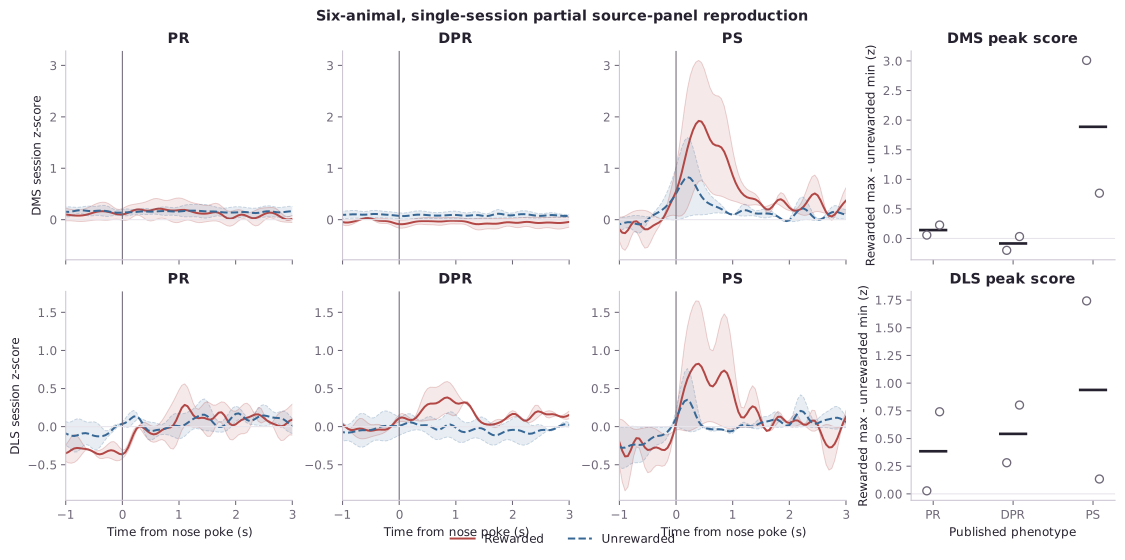
This figure deliberately mirrors the source panel's estimand and visual grammar before introducing the package's alternative robustness analysis. It is a partial source-panel reproduction, not numerical parity with the full study. See the paper-figure correspondence register and regenerate it from the six pinned NWB assets with:
The frozen reference workflow—3 Hz zero-phase filtering, robust IRLS reference fit, fitted-reference dF/F, and a 0-1.5 second response—estimated:
- rewarded minus unrewarded DMS response: 0.00693 ΔF/F;
- 95% paired Student interval: −0.00731 to 0.02118 ΔF/F;
- descriptive paired-test p-value: 0.266.
The point estimate is positive, but the interval contains both negative and positive population values. This six-animal demonstration therefore does not establish a non-zero population contrast. That is not a product failure: the report correctly prevents hundreds of events from creating spurious precision.
Individual animal contrasts were heterogeneous, ranging from approximately −0.00454 to 0.03322 ΔF/F. Two of six were slightly negative. The published PR, DPR, and PS labels were deliberately not modeled, so this result says nothing about phenotype differences.
Robustness result
All eight frozen universes executed successfully:
- estimate range: 0.00676 to 0.00694 ΔF/F;
- median estimate: 0.00686 ΔF/F;
- fraction positive: 8/8;
- blocked, failed, or incompatible universes: 0.
Median estimates were almost unchanged across unfiltered OLS, unfiltered IRLS, filtered OLS, and filtered IRLS. The 0-0.5 second window produced a slightly lower median (0.00678) than the 0-1.5 second window (0.00693), but this shift was tiny relative to animal-level uncertainty.
Leave-one-animal-out reference estimates remained positive from 0.00168 to 0.00923 ΔF/F. The direction is therefore not created by one animal, although omitting animal 112-283 substantially attenuates the estimate and exposes its influence.
Product interpretation
This result demonstrates why the product needs both a primary workflow and a multiverse. The primary interval answers how uncertain the animal-level estimate is; the multiverse answers whether reasonable analysis choices materially move that estimate. Here those answers differ:
- method robustness is high—filtering, reference estimator, and response window barely alter the point estimate;
- population precision is low—six heterogeneous animals permit a wide interval.
A conventional event-level analysis could obscure that distinction. The evidence bundle instead shows the event denominator, independent-unit boundary, preprocessing provenance, complete decision space, and influence diagnostic in one rerunnable result.
Limits
- This is a deliberately balanced six-animal teaching cohort, not a representative sample of the source population.
- The same public recordings underlie the source paper, so qualitative agreement is a reanalysis rather than independent replication.
- The source-panel reproduction is limited to one session from two animals per phenotype; its SEM is descriptive and must not be read as full-cohort precision.
- The scalar mean-window contrast is not the source paper's peak-based statistic.
- The isosbestic measurement is a reference channel, not guaranteed motion-only or biologically inert ground truth.
- Robustness across eight specified workflows does not imply robustness to every scientifically plausible preprocessing or inferential model.
Sources
- Seiler et al. (2022), source study.
- Seiler et al. (2026), immutable public data.
- DANDI, official example notebook.
- CatalystNeuro, NWB conversion provenance.