Animal-level peri-event inference v0.1
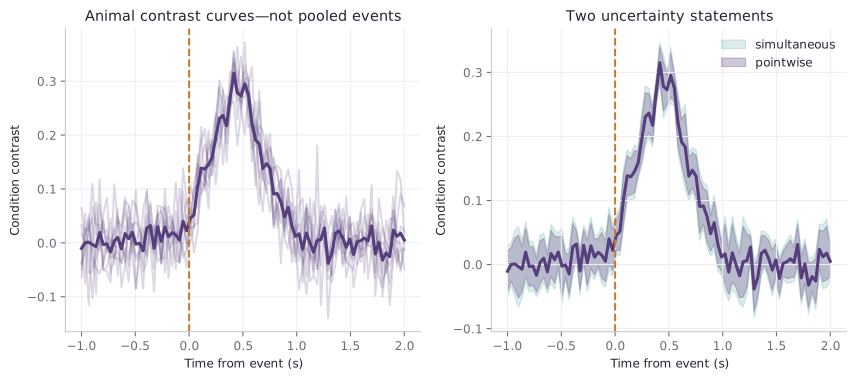
FiberPhotometry can add a time-resolved evidence lane to the existing scalar event contrast without treating events as independent replicates. The result retains the complete session-to-animal evidence chain rather than only the final population curve.
from fiberphotometry import EventAnalysis, PeriEventInferenceSpec

study = EventAnalysis(
    sessions,
    numerator="correct",
    denominator="incorrect",
    channel="DMS",
    preprocessing=preprocessing,
    timecourse=PeriEventInferenceSpec(
        window=(-1.0, 2.0),
        rate_hz=20,
        confidence=0.95,
        draws=2_000,
        seed=7,
    ),
)
Experimental unit and aggregation
The input remains event-level so individual observations and missing windows stay visible. Inference does not operate on events directly:
- Events are averaged within each session and condition.
- Session-condition means are averaged equally within each animal.
- The numerator-minus-denominator curve is formed for each animal.
- Only those animal contrast curves are resampled.
Duplicating events within a session therefore leaves the estimate, standard error, and interval unchanged. An animal must contribute both contrast conditions, and at least two animals must support a time point.
The serialized result includes every session-condition curve with event counts, every animal-condition curve with source sessions and pointwise support, incomplete animal identifiers, and a leave-one-animal-out population curve for each included animal. This makes unequal trial yield and influential animals inspectable without turning them into population replicates.
Paired and independent populations
The default design="paired" answers a within-animal contrast. Only complete
animal pairs enter the population curve; incomplete animals remain visible in the
result ledger.
For a between-animal experiment, conditions must be constant at the animal level and animal identifiers must be disjoint. Declare that design rather than asking the software to infer it from the observed labels:
study = EventAnalysis(
    sessions,
    numerator="drug",
    denominator="control",
    channel="DMS",
    preprocessing=preprocessing,
    factor_assignment_unit="animal",
    timecourse=PeriEventInferenceSpec(
        design="independent",
        window=(-1.0, 2.0),
        draws=2_000,
        seed=7,
    ),
)
Independent inference forms one curve per animal, contrasts the two group means, uses a pointwise Welch standard error, and resamples animals separately within group. Each group requires at least two animals.
Two different uncertainty statements
The pointwise percentile interval describes uncertainty separately at each relative time. It does not cover a scientist scanning the entire curve for an interesting time point.
The simultaneous band uses the bootstrap distribution of the maximum absolute standardized deviation over the declared window. Its critical value expands a single band around the animal-level estimate, providing a whole-window confidence statement under the declared bootstrap assumptions. For small samples, the critical value cannot fall below the ordinary two-sided animal-level t critical value; this conservative floor prevents a sparse empirical bootstrap from making the simultaneous band misleadingly narrow. This is not a cluster-based test and does not infer a privileged onset or duration.
The result records both bands, group-specific pointwise animal support, seed, draw count, critical value, Hedges standardized effects, and warnings for changing support or zero-variance points. The HTML report draws the simultaneous band behind the pointwise interval and summarizes the largest leave-one-animal-out change. JSON retains the complete numeric arrays and ledgers.
Scope and limitations
- This v0.1 method addresses paired within-animal and independent between-animal two-level contrasts.
- Equal session weighting is the only supported within-animal policy.
- Missing values are retained; support may vary by time and is reported.
- The band reflects between-animal uncertainty, conditional on the observed sessions and preprocessing workflow.
- Factorial interactions, continuous covariates, generalized outcomes, and functional mixed models are not yet supported.
- It does not replace functional mixed models, cluster permutation tests, or a prespecified scalar estimand when those answer a different question.
The low-level infer_peri_event_contrast API accepts an event-by-time matrix plus
animal, session, and condition labels for integrations outside EventAnalysis.
Its design argument is required whenever the intended design is independent.
When two independent groups each contribute both repeated conditions, use
infer_peri_event_interaction() rather than running separate group analyses. The
group-by-condition interaction contract retains
the same session and animal evidence while directly estimating the difference in
differences.
The shared result semantics are described in Animal estimates and population contrasts.