Coordinate-aware dense multi-fiber networks
Use this experimental workflow when three or more simultaneously sampled photometry channels have physical or atlas coordinates and the question concerns the spatial organization of their association. It extends the guarded pairwise workflow; it does not turn fibers or edges into independent experimental units.
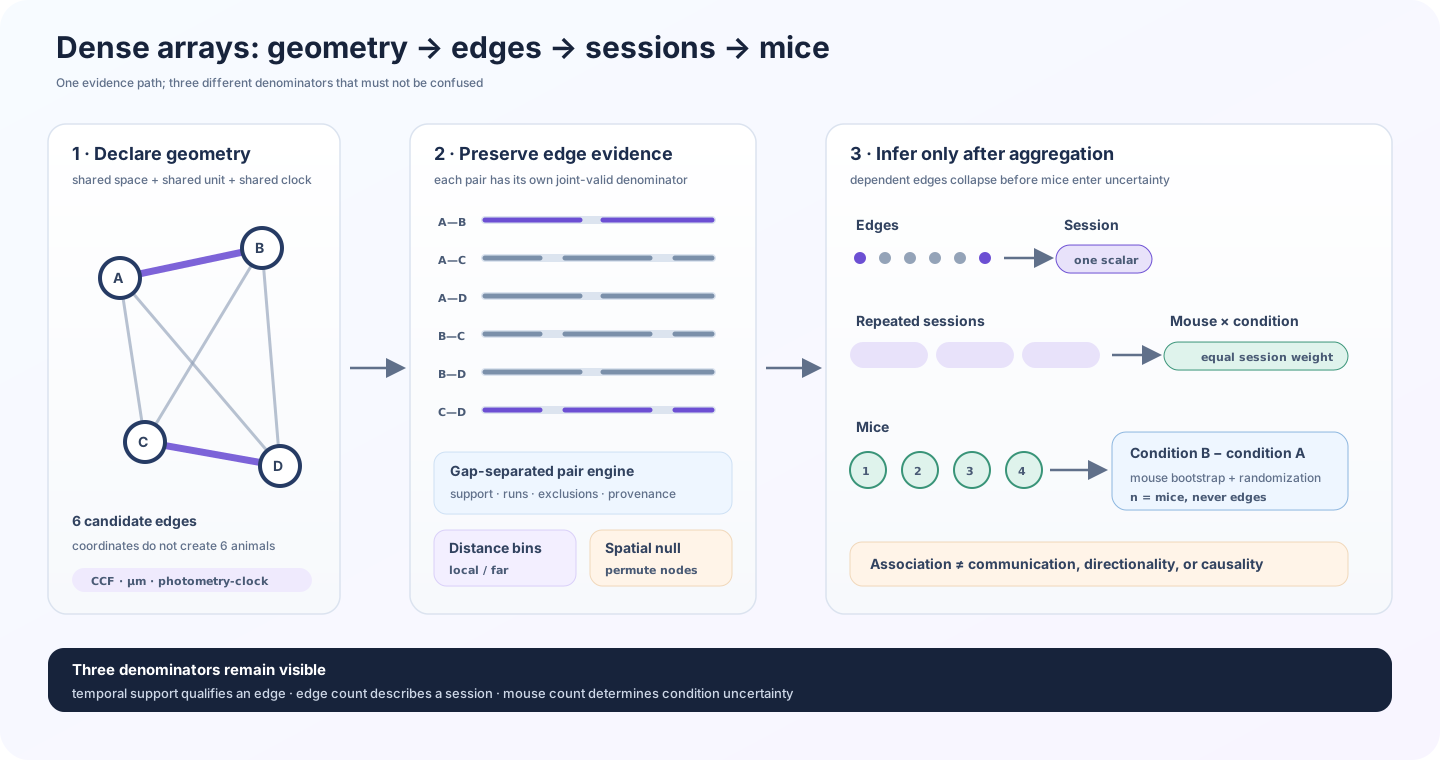
Declare one array
Every channel requires a unique ID and a SpatialCoordinate. Coordinates must
share both a unit and a named space; millimetres in implant space cannot silently
mix with micrometres in an atlas space.
from fiberphotometry import (
    ChannelIdentity,
    SpatialArrayMetadata,
    SpatialCoordinate,
)

channels = tuple(
    ChannelIdentity(
        channel_id=f"fiber-{index}",
        site=site,
        sensor="dLight1.3b",
        role="sensor",
        unit="dF/F",
        fiber_id=f"fiber-{index}",
        coordinate=SpatialCoordinate(x, y, z, unit="um", space="CCF"),
    )
    for index, (site, x, y, z) in enumerate(
        (
            ("DMS-a", 1120, 760, -3180),
            ("DMS-b", 1280, 780, -3200),
            ("NAc-a", 980, 1280, -4020),
            ("NAc-b", 1140, 1300, -4000),
        )
    )
)

metadata = SpatialArrayMetadata(
    subject="mouse-01",
    session="day-01",
    array_id="implant-01",
    channels=channels,
    clock_id="photometry-clock",
    alignment_policy="native_shared_clock",
    preprocessing_fingerprint="sha256:...",
)
At least three channels are required because the spatial statistic needs more than a single pair. The API accepts a single shared timestamp vector and a time-by-channel value matrix. Use matched-pulse synchronization and explicit resampling before this boundary when acquisition clocks differ.
Estimate the session network
from fiberphotometry import (
    LaggedAssociationSpec,
    SpatialDistanceBin,
    SpatialNetworkSpec,
    SpatialNodePermutationSpec,
    estimate_spatial_network,
)

network = estimate_spatial_network(
    time_s,
    signals,  # time × channel, in metadata channel order
    metadata,
    SpatialNetworkSpec(
        association=LaggedAssociationSpec(
            maximum_lag_s=1.0,
            minimum_pairs_per_lag=100,
        ),
        edge_metric="zero_lag_correlation",
        correlation_scale="fisher_z",
        minimum_edge_support=100,
        distance_bins=(
            SpatialDistanceBin("local", 0, 250),
            SpatialDistanceBin("intermediate", 250, 750),
            SpatialDistanceBin("long", 750, 1500),
        ),
        node_permutation=SpatialNodePermutationSpec(
            resamples=5000,
            seed=2026,
        ),
    ),
    valid=channel_valid,  # optional time × channel mask
    covariates=behavior_design,
    covariate_names=("movement", "reward_kernel"),
)
The function materializes every declared pair through lagged_association.
Consequently, each edge inherits the same protections as the pairwise API:
- timestamp gaps and invalid samples split continuity runs rather than being compressed away;
- a sample contributes only when both channels and all declared covariates are valid;
- residualization is fit separately within each continuity run;
- support is retained per lag; and
- optional blocked pairwise nulls remain labeled as within-session sensitivity analyses.
The default edge is zero-lag correlation. peak_absolute_correlation instead
selects the tested lag with the largest absolute correlation while retaining its
sign and lag. This is association, not directionality or causal connectivity.
Read the network artifact
SpatialNetworkResult contains a complete candidate-edge ledger:
edgesrecords sites, distance, raw and Fisher-transformed values, support, peak lag, continuity runs, gaps and any pairwise-null probability;exclusionsrecords failed pairs, non-finite estimates and insufficient support rather than silently shrinking the network;distance_summariesreports the unweighted mean edge association within each declared physical-distance bin;global_associationsummarizes all retained edges; andevidence_fingerprintbinds values, masks, geometry, specifications and covariate names.
Correlation averaging defaults to Fisher's z scale and returns to correlation units for reporting. Edges are not weighted by their sample count: support is a quality denominator, not permission for a long recording or highly sampled pair to define the biological estimand.
Test spatial organization within a session
The node-label null asks whether edge association is related to physical distance more strongly than expected if the observed signals occupied different declared coordinates. Each draw permutes coordinates across nodes, recomputes all retained edge distances, and records the Pearson correlation between distance and transformed edge association.
This preserves the observed signals and network topology. It does not preserve
arbitrary anatomical strata, hemispheres or probe-layout constraints. When those
exchangeability restrictions matter, omit node_permutation and treat a custom
restricted null as an extension; an unrestricted p-value would be misleading.
Arrays with too few retained edges or constant distances/values return a typed
performed=False result with an exclusion reason.
Contrast conditions at the mouse level
from fiberphotometry import (
    SpatialAnimalInferenceSpec,
    SpatialStudySession,
    infer_spatial_network_animals,
)

study_sessions = [
    SpatialStudySession(condition=row.condition, result=row.network)
    for row in session_results
]

contrast = infer_spatial_network_animals(
    study_sessions,
    SpatialAnimalInferenceSpec(
        metric="distance_bin_association",
        distance_bin_name="local",
        condition_a="baseline",
        condition_b="drug",
        design="paired",
        session_aggregation="mean",
        bootstrap_resamples=10000,
        permutation_resamples=10000,
        seed=2026,
    ),
)
Available scalar estimands are global association, one declared distance bin, the distance-edge correlation, or the mean strength of edges touching one named site. The aggregation order is fixed:
- dependent edges become one session scalar;
- repeated sessions receive equal weight within each mouse and condition; and
- bootstrap intervals and randomization tests resample or permute mice.
For paired designs, incomplete mice are listed in excluded_subjects. The effect
direction is always condition B minus condition A. Edge count and total temporal
support remain attached to both session and mouse summaries but never determine
the number of experimental units. A requested session that cannot produce the
declared estimand is retained in session_exclusions with a typed reason.
Product boundaries and next validation
This API supports descriptive spatial networks, distance gradients and mouse-level condition contrasts. It intentionally does not claim:
- effective connectivity, information flow or causal influence;
- automatic crosstalk removal or optical source separation;
- anatomical registration from unlabeled device coordinates;
- graph-theoretic independence among edges; or
- validated performance on every dense-array acquisition system.
Run crosstalk and shared-control review and, when applicable, wavelength-aware optical unmixing before interpreting high zero-lag structure. Raw-system fixtures with known geometry, injected shared artifacts and repeated animals remain the important validation gap.
The governing policy is recorded in SDR-0053.