Animal estimates and population contrasts v0.1
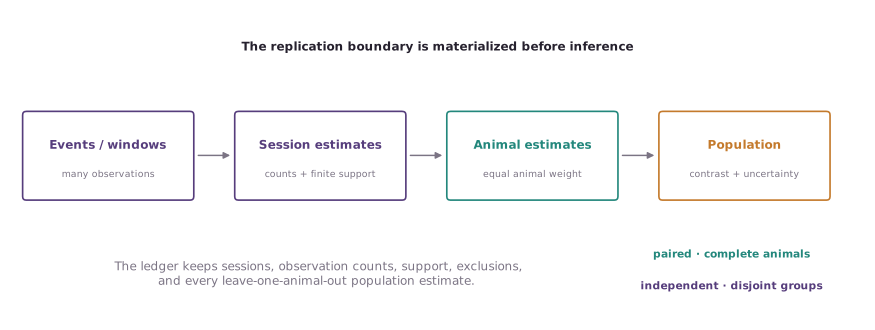
FiberPhotometry separates the measurements used to estimate an animal from the animals used to estimate a population. This boundary is reusable across scalar responses and vector outcomes such as peri-event curves.
The evidence chain
events, windows, or detected features
  -> session-condition estimates
  -> animal-condition estimates
  -> declared paired or independent population contrast
Every PopulationUnitEstimate contains an animal identifier, contrast level,
estimate, source-session identifiers, observation count, and pointwise source
support. infer_population_contrast() receives only these materialized animal
estimates. It never treats their contributing events or windows as independent
population replicates.
Supported designs
Paired
Use a paired design when every included animal contributes both levels. The
population estimate is the mean within-animal difference. Animals missing either
level are listed in excluded_units; they are not silently treated as independent
observations.
Independent
Use an independent design for a between-animal comparison. Animal identifiers must be disjoint across levels, and each level needs at least two animals. Group means are contrasted with a Welch standard error, while bootstrap draws resample animals separately within each group.
from fiberphotometry import (
    PopulationContrastSpec,
    PopulationUnitEstimate,
    infer_population_contrast,
)

animals = (
    PopulationUnitEstimate(
        unit_id="control-01",
        level="control",
        estimate=(0.12,),
        support=(2,),
        source_units=("session-01", "session-02"),
        observation_count=18,
    ),
    # Additional animals from both disjoint groups...
)

result = infer_population_contrast(
    animals,
    PopulationContrastSpec(
        numerator="drug",
        denominator="control",
        design="independent",
        draws=2_000,
        seed=7,
    ),
)
Scalar outcomes use a one-element estimate. Curves, spectra, and other ordered
outcomes use longer tuples with a common shape.
What the result makes inspectable
- the population estimate in the original measurement units;
- pointwise standard errors and Hedges standardized effects;
- pointwise bootstrap intervals and a simultaneous max-t band;
- numerator, denominator, and contrast support at every outcome point;
- included and incomplete animals;
- the complete animal-estimate ledger; and
- the population curve after leaving out each animal, plus its maximum deviation.
The simultaneous band is a whole-outcome uncertainty statement under the declared bootstrap design. It is not a cluster test and does not identify a response onset. Pointwise standardized effects are secondary descriptions, not permission to scan for the largest effect without accounting for selection.
Where domain rules still belong
The common layer starts only after animal estimates exist. Analysis-specific code must still decide how to form them. For example, transient rates pool counts over finite exposure, while peri-event kinetics average session-condition curves equally within animal. A generic population function must not erase those denominators.
Current boundary
Version 0.1 supports two-level paired and independent contrasts. Factorial designs, group-by-condition interactions, continuous covariates, generalized count models, crossed effects, and functional mixed models remain explicit gaps. Those extensions require estimand-specific simulations rather than a formula-only interface.
The test suite includes seeded small-sample Gaussian coverage regressions for both designs. These guard against obvious interval regressions; they are not a claim of calibration under skew, heteroscedasticity, informative missingness, or preprocessing selection. Broader scenario calibration remains required before promoting the resampling API beyond its current experimental boundary.
The first constrained extension is the two-group × two-condition interaction, which forms a repeated-condition contrast within each complete animal before comparing those contrasts across disjoint groups.
Typed materializers now expose this same boundary for spontaneous transients, state-band power, and multi-signal association without erasing their domain-specific exposure, window, or pair-count denominators. The population-curve workflow carries complete frequency and lag axes through the same vector contract with pointwise support.
The governing rationale is recorded in SDR-0055.