Behavioral ecosystem interoperability
FiberPhotometry does not need to rediscover behavior to relate behavior to neural signals. It needs a loss-aware boundary to tools that already estimate pose, discover behavioral states, or record an ethogram.
Experimental v0.1 boundary
Typed in-memory and file adapters are implemented. Checksum-pinned official SLEAP and BORIS fixtures pass; DeepLabCut and Keypoint-MoSeq currently have documented-schema fixtures only. See the validation matrix.
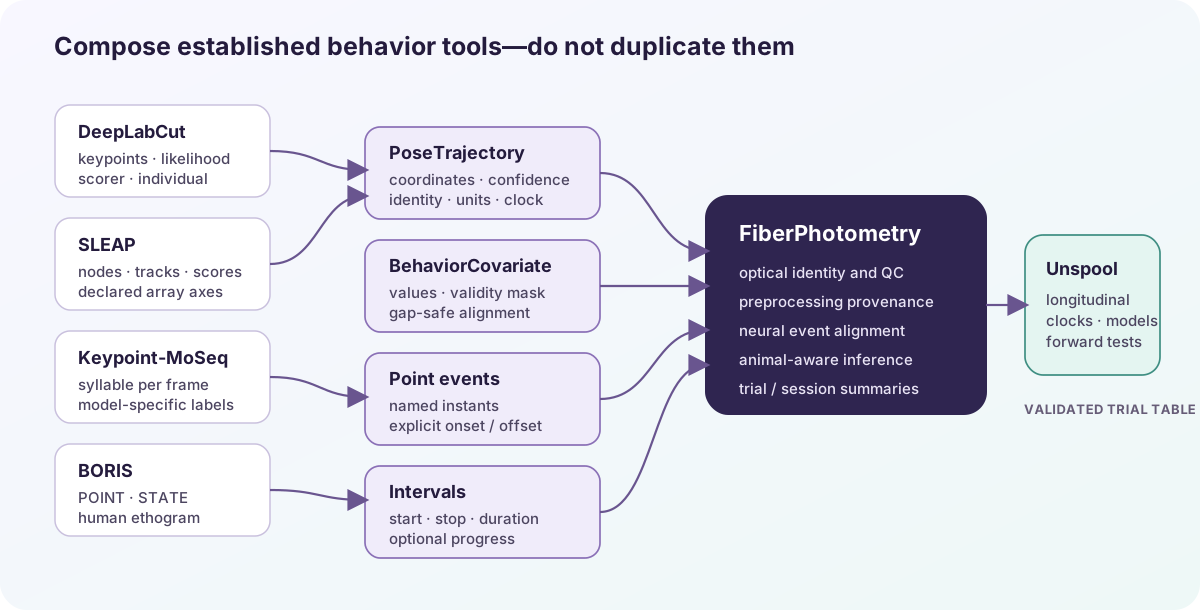
What each package owns
| Package or tool | Owns | FiberPhotometry consumes |
|---|---|---|
| DeepLabCut | markerless pose inference, scorer and individual identity | keypoint coordinates and likelihood by video frame |
| SLEAP | single- and multi-animal pose inference and tracking | node coordinates, track identity and point scores |
| Keypoint-MoSeq | unsupervised behavioral state discovery | frame-level syllable labels, run-length encoded as bouts |
| BORIS | human ethogram annotation | distinct point events and state intervals |
| FiberPhotometry | optical signal identity, QC, preprocessing, neural alignment and inference | the typed boundaries below |
| Unspool | longitudinal behavioral clocks, models and prospective validation | trial-level neural summaries with explicit subject/session/trial coordinates |
This division follows the scientific capabilities of the source tools. DeepLabCut
exports MultiIndex pose columns containing scorer, body part, coordinates and
likelihood. SLEAP Analysis HDF5 retains tracks, nodes and confidence-like scores.
Keypoint-MoSeq returns a syllable label per time point. BORIS explicitly
distinguishes point from state events. Flattening those outputs to an anonymous
time,value CSV would discard information that affects analysis.
Four exchange shapes
The public Python boundary deliberately uses a few small types rather than one universal table.
| Shape | Required meaning | Current type | Typical source |
|---|---|---|---|
| Pose trajectory | one keypoint, one tracked individual, coordinates, confidence and time | PoseTrajectory |
DeepLabCut, SLEAP |
| Continuous covariate | one named value and validity mask per source timestamp | BehaviorCovariate |
confidence-gated speed, pupil area, state probability |
| Point events | named instantaneous occurrences | BehaviorAnnotations.point_events |
BORIS POINT, cue timestamps |
| Intervals | named half-closed behavioral bouts with physical start and stop | BehaviorInterval |
BORIS STATE, MoSeq syllable run |
BehaviorAnnotations.event_times(edge="onset") provides an explicit projection
from intervals to event-kernel predictors. The original intervals are retained, so
an onset analysis does not silently become the only representation of the data.
normalized_progress() maps samples inside a declared bout to zero-to-one progress
while the source interval retains its physical duration.
For inference, interval_encoding_inputs() returns aligned edge events,
duration_s values, and physical bounds. ProgressKernelSpec then evaluates
normalized progress only inside each bout while retaining outside-bout samples as
zero-valued design rows. This avoids turning absence of a behavior into missing
data.
Clock, identity, confidence and units
Interoperability is valid only when these fields remain explicit:
subjectandsessionidentify the biological and recording units;individualdistinguishes tracks in multi-animal pose output;clock_idnames the time coordinate used by every timestamp;coordinate_unitand covariateunitprevent pixels from masquerading as centimetres;- confidence-like scores or likelihood determine a visible validity mask rather than an invisible fill operation;
source_versionandsource_artifactcan retain the producing software version and path, URI or digest-bearing artifact identity.
fit_clock_synchronization() consumes explicit pulse pairs observed on both
clocks, fits an affine offset-and-drift mapping, and refuses residual, drift,
pulse-count or span failures against prospective thresholds. Its artifact retains
every pulse residual and a stable evidence ID. Applying the mapping to pose,
covariates or annotations changes their clock ID and appends that evidence ID to
their lineage. See the clock synchronization contract.
Only after synchronization does BehaviorCovariate.aligned_to() interpolate onto
the photometry grid. It does not extrapolate or cross invalid samples or source
gaps larger than the declared maximum, and it retains the aligned validity mask;
align_to() is the numeric-array convenience form. Giving two unsynchronised
clocks the same name is not synchronisation.
Native adapters
DeepLabCut
pose_from_deeplabcut() reads a pandas-like result without taking a hard
dependency on DeepLabCut. pose_from_deeplabcut_file() reads prediction CSV or
pandas HDF5 with the optional behavior dependencies. Both require a scorer or
individual when the MultiIndex would otherwise select more than one
x/y/likelihood triplet.
from importlib.metadata import version

from fiberphotometry import pose_from_deeplabcut_file

pose = pose_from_deeplabcut_file(
    "sessionDLC_resnet50.h5",
    subject="mouse-07",
    session="day-04",
    keypoint="nose",
    scorer="DLC_resnet50_project",
    fps=30.0,
    clock_id="camera-0",
    source_version=version("deeplabcut"),
)
speed = pose.speed(minimum_confidence=0.9)
The likelihood threshold is an analysis choice and must be declared. The adapter does not adopt a universal cutoff or interpolate low-confidence coordinates.
SLEAP
pose_from_sleap() consumes dense arrays. pose_from_sleap_analysis_h5() reads
the file and uses its dimension attributes when present. Legacy files have no
dimension attributes, so the caller must declare them; Python-native and
MATLAB-compatible presets use different axis orders.
from fiberphotometry import pose_from_sleap_analysis_h5

pose = pose_from_sleap_analysis_h5(
    "predictions.analysis.h5",
    node="nose",
    dims=("track", "xy", "node", "frame"),
    subject="mouse-07",
    session="day-04",
    track=0,
    fps=30.0,
)
SLEAP point scores are confidence-like values, not guaranteed probabilities. An official legacy fixture contains scores above one, so only non-negativity is assumed; thresholds must be calibrated to the producing SLEAP version and model.
SLEAP also exports NWB through ndx-pose. FiberPhotometry now provides native
inspection, explicit estimator selection, 2D/3D import, schema-valid export, and a
tested file round trip while reporting device/video links that cannot be recreated
without destination objects. See the
native ndx-pose contract.
Keypoint-MoSeq
annotations_from_moseq() run-length encodes an in-memory syllable sequence.
annotations_from_moseq_results_h5() reads the documented recording hierarchy
directly. Each interval retains the full duration of one uninterrupted state.
from fiberphotometry import annotations_from_moseq_results_h5

states = annotations_from_moseq_results_h5(
    "moseq-project/model-a/results.h5",
    recording="recording-01",
    subject="mouse-07",
    session="day-04",
    fps=30.0,
    labels={0: "pause", 1: "rear"},
)
rear_onsets = states.event_times()["rear"]
Syllable numbers are model-specific, may be reindexed, and are not universal behavior names. A semantic label mapping is therefore optional and provenance of the fitted MoSeq model remains essential.
BORIS
annotations_from_boris() consumes already-loaded aggregated columns.
annotations_from_boris_aggregated_file() reads BORIS aggregated CSV/TSV directly.
annotations_from_boris_tabular_file() handles the other common shape: a metadata
preamble followed by START/STOP or point-event rows.
annotations = annotations_from_boris_tabular_file(
    "mouse-07-day-04-boris.csv",
    subject="mouse-07",
    session="day-04",
    source_subject="mouse-07",
)

aggregated = annotations_from_boris_aggregated_file(
    "mouse-07-day-04-aggregated.tsv",
    subject="mouse-07",
    session="day-04",
    source_subject="mouse-07",
)
In tabular files, blank or POINT status rows become point events and START/STOP rows are paired as intervals. In aggregated tables, POINT and STATE types are handled directly. Invalid, unmatched or unknown rows are rejected.
From behavior to neural and longitudinal questions
The immediate FiberPhotometry composition is:
- transform pose into a declared covariate, such as confidence-gated speed;
- synchronize it to the photometry clock from explicit matched pulses and retain the synchronization artifact;
- align it without crossing invalid spans and retain the resulting mask;
- use point events, explicit interval edges, covariate values and masks in an
EncodingSession; the model reports complete-case coverage without compressing time; and - summarize declared neural estimands at the trial or session level and pass them
through
prepare_unspool_study().
See the worked interoperability tutorial and the auditable interval-policy contract. The separate Unspool contract begins only after declared neural summaries and across-session comparability evidence exist.
Gaps exposed by the examples
| Priority | Missing ecosystem capability | Likely home |
|---|---|---|
| P0 | extend the now-complete one-version fixture matrix across a second released version and one real camera-to-photometry synchronization record | adapter validation in FiberPhotometry |
| P1 | bounded remote ndx-pose series access and a real camera-to-photometry synchronization fixture |
FiberPhotometry I/O and validation |
| P1 | broaden interval-policy fixtures to real multi-label annotations and a second source-tool version | FiberPhotometry interoperability validation |
| P1 | multi-animal identity-switch diagnostics at the neural-alignment boundary | source-tool QC plus FiberPhotometry preflight |
| P1 | versioned behavioral interchange artifact with hashes and confidence semantics | shared package after a second consumer adopts it |
| P2 | adapters for SimBA, B-SOiD and user-supplied state probabilities | thin FiberPhotometry adapters |
A gap should become a separate library only when it has an independent object model, at least two consuming packages, and useful validation outside photometry. On that test, the new clock transform should move to a shared ecosystem package if Unspool becomes a second direct consumer. A provenance-rich behavioral interchange artifact is another plausible shared library. Photometry-specific kernels and optical QC remain here; longitudinal model families remain in Unspool.