Event-kernel interval calibration v0.1
The candidate simultaneous band did not pass its frozen gate
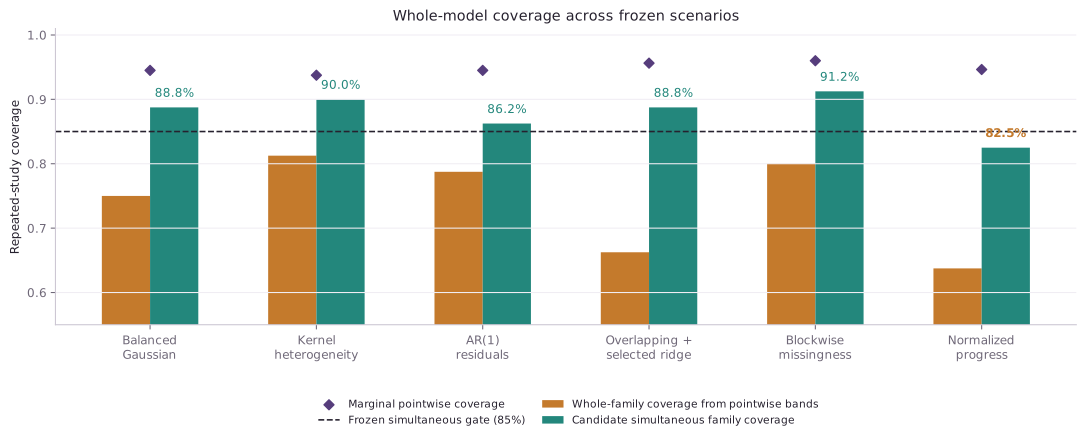
Whole-family coverage reached 82.5% for normalized-progress kernels, below the prespecified 85% minimum. The method remains an explicit experimental opt-in and ordinary encoding fits continue to report pointwise sensitivity intervals only.
Why this benchmark exists
The encoding model estimates a curve at many lags or progress positions. A pointwise interval can behave reasonably at each position while failing to cover the complete generating curve. That distinction matters when scientists inspect a whole response shape or select its apparent peak.
The v0.1 protocol was committed before the 80-study aggregate execution. It evaluated the existing group-jackknife pointwise interval and a candidate Gaussian-multiplier max-t band. The multiplier family contained every evaluated position from every event and progress kernel in the fitted model. This follows the general multiplier- maximum strategy studied by Chernozhukov, Chetverikov, and Kato (2014), but the finite photometry implementation still requires its own empirical calibration.
Frozen result
Each scenario contains 80 independently seeded studies. “Marginal pointwise” is the fraction of individual curve positions covered. The two family columns require every position in a study to cover simultaneously.
| Scenario | Marginal pointwise | Pointwise family | Candidate simultaneous | Gate |
|---|---|---|---|---|
| Balanced Gaussian FIR | 94.5% | 75.0% | 88.8% | Pass |
| Animal kernel heterogeneity | 93.8% | 81.2% | 90.0% | Pass |
| AR(1) residuals, \(\phi=0.65\) | 94.5% | 78.8% | 86.2% | Pass |
| Overlapping cue/reward + movement + selected ridge | 95.6% | 66.2% | 88.8% | Pass |
| Blockwise missing response samples | 96.0% | 80.0% | 91.2% | Pass |
| Six-animal normalized progress | 94.6% | 63.7% | 82.5% | Fail |
All 480 declared fits succeeded, all bounds were finite, and simultaneous widths were never narrower than their pointwise counterparts. Median simultaneous critical values ranged from 2.87 to 3.44. The candidate materially improved whole-family coverage over pointwise bands, especially for the ten-point overlapping-event family, but improvement is not the same as calibration.
The complete study-level ledger is retained in
event-kernel-interval-coverage-v0.1.json.
Reproduce it with:
uv run python scripts/run_event_kernel_interval_calibration.py
uv run --group docs python scripts/plot_event_kernel_interval_calibration.py
Product consequence
The default remains explicit and pointwise:
from fiberphotometry import EncodingModelSpec, KernelUncertaintySpec

model = EncodingModelSpec(
    event_kernels=(cue,),
    uncertainty=KernelUncertaintySpec(confidence_level=0.95),
)
Researchers reproducing or developing the candidate can opt in without confusing it with the default:
from fiberphotometry import MultiplierSimultaneousBandSpec

model = EncodingModelSpec(
    event_kernels=(cue, reward),
    uncertainty=MultiplierSimultaneousBandSpec(
        confidence_level=0.95,
        simultaneous_draws=2_000,
        simultaneous_seed=20_260_727,
    ),
)
The result then stores optional simultaneous_lower and simultaneous_upper
arrays plus method, seed, draws, complete family size, and critical value. The band
is still conditional on the selected ridge penalty and fitted model. It is not
selective inference, a cluster test, or a license to interpret zero exclusion as a
causal effect.
What happens next
The failure is localized enough to guide the next benchmark rather than invite a post-hoc threshold change. The next protocol should investigate progress-basis evaluation and six-animal finite-group behavior, add heterogeneous progress trajectories, and compare the fixed multiplier approximation with nested group bootstrap or analytically conservative alternatives. Any replacement needs a new frozen protocol and independent seeds.
The decision to retain but not promote the candidate is recorded in SDR-0040.