Behavioral event-kernel encoding
Experimental
This is a first vertical slice, not yet a supported inferential workflow. It estimates predictive kernels and validates predictions across held-out animals or sessions. Grouped-jackknife intervals and the explicitly opt-in simultaneous candidate are conditional sensitivity summaries, not promotion-grade confidence bands or causal effects.
Scientific question
How much of a continuously sampled, already-corrected photometry signal is predictable from overlapping task events and continuous behavioral measurements?
The model is a Gaussian finite-impulse-response (FIR) encoding model:
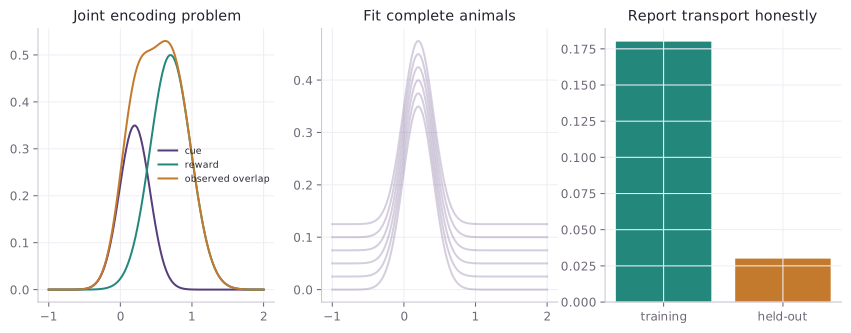
Each event type has its own declared lag window. Overlapping cue, action, reward, and omission responses are estimated jointly rather than assigned to separate peri-event averages. Continuous predictors such as motion are standardized using training data only. Ridge strength is selected by mean group-wise held-out \(R^2\), with complete animals or complete sessions kept together.
Kernel bases
The default FIRBasisSpec estimates one unconstrained coefficient per sampled lag,
preserving the original behavior. A lower-dimensional smooth alternative is
explicit:
from fiberphotometry import EventKernelSpec, RaisedCosineBasisSpec

cue = EventKernelSpec(
    "cue",
    (-1.0, 3.0),
    basis=RaisedCosineBasisSpec(functions=8),
)
Raised-cosine functions are linearly spaced across the sampled window and row-normalized. Their count must not exceed the number of sampled lags, and the resulting basis must have full column rank. This is a shape assumption and should be declared as an alternative, not adopted after inspecting a noisy FIR curve.
Fitting occurs in basis space. Every result nevertheless reports the reconstructed kernel and grouped-jackknife interval on the original lag grid in seconds. It also stores the basis family, component labels, fitted basis weights and sampled basis functions. Thus plots remain physically interpretable while the exact fitted parameterization is reproducible.
Event values and within-session history
A second kernel can reuse an event train while being multiplied by a declared
per-event value. Setting lag_events=1 makes that value come from the immediately
previous occurrence within the same session:
from fiberphotometry import EventKernelSpec, EventModulationSpec

history = EventKernelSpec(
    "cue-by-previous-outcome",
    (-1.0, 3.0),
    source_event="cue",
    modulation=EventModulationSpec(
        value="outcome_code",
        lag_events=1,
        unavailable_value=0.0,
    ),
)
The session supplies one finite outcome_code per cue through event_values.
History resets at recording boundaries and lagged events must be strictly ordered.
FiberPhotometry neither guesses categorical coding nor standardizes these values;
zero must therefore have the intended meaning. Include the unmodulated cue kernel
to interpret the history kernel as a conditional difference around that reference.
Use lag zero for a declared current-event amplitude or duration.
Variable-duration behavior
ProgressKernelSpec models the trajectory within a physical interval without
discarding the rest of the recording. A piecewise-linear basis maps samples inside
each bout to normalized progress; all progress columns are zero outside bouts.
from fiberphotometry import LinearProgressBasisSpec, ProgressKernelSpec

rear_progress = ProgressKernelSpec(
    "rear-progress",
    source_interval="rear",
    basis=LinearProgressBasisSpec(functions=5),
)
The result reconstructs the trajectory and grouped uncertainty on an explicit
progress grid from zero to one while retaining the physical interval source and
bout count. BehaviorAnnotations.interval_encoding_inputs() provides aligned
edge events, duration_s values, and interval bounds from MoSeq or BORIS inputs.
Onset/offset kernels, duration-modulated kernels, and progress kernels remain
separate declared predictors and should be compared as named alternatives.
This follows the behavioral-regression use case discussed in the fiber-photometry analysis primer and the multi-signal Gaussian GLM presented in the COSYNE 2024 programme, abstract 2-005. Those examples motivate the model family; they do not validate this implementation.
Inputs and estimand
- One regular time grid and corrected response per session.
- Explicit event times, with a lag window declared for each event type.
- Optional continuous covariates sampled on the response grid.
- Optional physical interval bounds for normalized-progress kernels.
- Optional boolean validity masks for the response and each continuous covariate.
- Stable animal and session identities.
An event coefficient is the conditional response-unit change for one event impulse at that lag, holding the other declared predictors fixed. A continuous coefficient is the conditional response-unit change per one training-set standard deviation. The held-out score is predictive performance, not evidence that a predictor caused the fluorescence response.
Safeguards
- FIR matrices are built independently within sessions; convolution never crosses a recording boundary.
- Cross-validation holds out complete biological groups.
- Continuous scaling is learned in each training fold and applied unchanged to its held-out groups.
- Irregular grids are rejected. Resampling must be an explicit earlier operation.
- Response and selected-covariate masks are combined by an explicit complete-case policy. No value is imputed and retained timestamps are never compressed.
- Every session must retain at least 50% and three observations by default; both thresholds are configurable and recorded in the result.
- The result reports total, retained and excluded observations, response and per-covariate invalid counts, and the number of contiguous retained runs for every session.
- Missing predictors, absent event types, duplicate animal/session identities, and constant training covariates fail loudly.
- Event kernels fail if masking removes all retained support for any requested lag.
- Progress kernels reject missing, out-of-recording, unordered, overlapping, or unsupported interval families; outside-bout time remains retained.
- Every tested ridge penalty and every fold score is retained in the result.
- Delete-one-group kernel refits use the selected penalty unchanged and retain every omitted identity.
- Residual diagnostics use only group-held-out predictions; lagged calculations restart at session boundaries and on both sides of every excluded span.
Missingness and coverage
Validity is evidence, not a preprocessing nuisance. response_valid and
continuous_covariate_validity preserve explicit upstream decisions such as
pose-confidence gates, occlusions, stimulation-artifact windows or unavailable
response samples. Non-finite values are invalid regardless of the supplied mask.
Only covariates named in the model specification contribute to its complete-case
mask.
The result artifact schema v7 contains an EncodingValidityReport. Its per-session
records make the model denominator auditable and distinguish invalid response
samples from invalid samples for each selected covariate. Counts can overlap: the
overall excluded count is the union, not the sum of reason counts. Each record also
contains a fingerprint of the exact retained sample indices so robustness workflows
can distinguish equal counts from genuinely identical denominators.
Complete-case fitting is deliberately conservative and does not claim that data are missing completely at random. If missingness relates to behavior or signal amplitude, the fitted estimand may describe a selected subset of time. Scientists should compare retained coverage across animals and conditions and treat large or structured exclusions as a design problem. The coverage floor is a fail-fast guardrail, not a universal scientific adequacy threshold.
Uncertainty and diagnostics
Each event kernel includes a delete-one-group jackknife sensitivity interval. By default, one complete animal is removed per replicate. The result stores the full-data coefficient, bias-corrected jackknife estimate, standard error, and pointwise 95% Student interval at every lag. These intervals quantify sensitivity of the pooled regularized estimator to independent groups.
They are conditional on the ridge penalty selected using the full dataset. They do not account for model-selection uncertainty and are not simultaneous across lags. The first frozen calibration found 93.8–96.0% marginal pointwise coverage but much lower whole-family coverage, as expected. With few animals, interpret them as influence-aware sensitivity summaries rather than binary tests.
An explicitly typed MultiplierSimultaneousBandSpec asks for one seeded max-t
critical value across every evaluated position from every kernel in the model. It
is not the default: the
480-study calibration missed its
frozen normalized-progress gate (82.5% versus an 85% minimum). Candidate results
retain method, seed, draw count, family size, critical value and nullable
simultaneous bounds. KernelUncertaintySpec remains pointwise-only.
For every animal or session, the model also reports out-of-fold R², RMSE, MAE, residual bias and spread, lag-1 residual autocorrelation, and Durbin–Watson ratio. The latter two are descriptive warnings about remaining temporal structure, not formal p-value-producing tests.
Current limitations
The response must already have undergone a scientifically defensible correction; the encoding model does not decide between isosbestic, regression, or control-free preprocessing. Autocorrelated residuals make ordinary sample-level standard errors unsafe; the grouped jackknife does not repair a misspecified temporal model. The workflow still lacks a fully calibrated simultaneous kernel band, selective inference, nonlinear terms, nested hyperparameter selection, blocked-within-session validation, and missingness-mechanism models or imputation.
The first public-data reproduction retained slightly negative mean animal-held-out prediction in both modeled regions and selected the largest declared ridge penalty. This validates execution and failure transparency, not scientific sufficiency. Its v0.2 rerun found substantial held-out residual autocorrelation and wide group-sensitivity intervals. Named model multiverses and paired predictor-family contribution summaries now cover explicit design comparisons. Promotion priorities are nested or independently frozen penalty selection, blocked validation where scientifically appropriate, and a new interval protocol after the retained v0.1 progress-kernel failure.
See the worked simulation and model-multiverse workflow. The grouped validation policy is recorded in SDR-0027. The promotion decision is recorded in SDR-0028. The validity policy is recorded in SDR-0033. Typed basis reconstruction is governed by SDR-0036. Within-session event modulation and history are governed by SDR-0037. Variable-duration progress modeling is governed by SDR-0038.