Detect spontaneous transients without hiding the method choice
This worked simulation asks a narrow question: can we recover isolated events while keeping acquisition gaps out of the event-rate denominator? It also demonstrates why the detector should be treated as a small multiverse rather than a button.
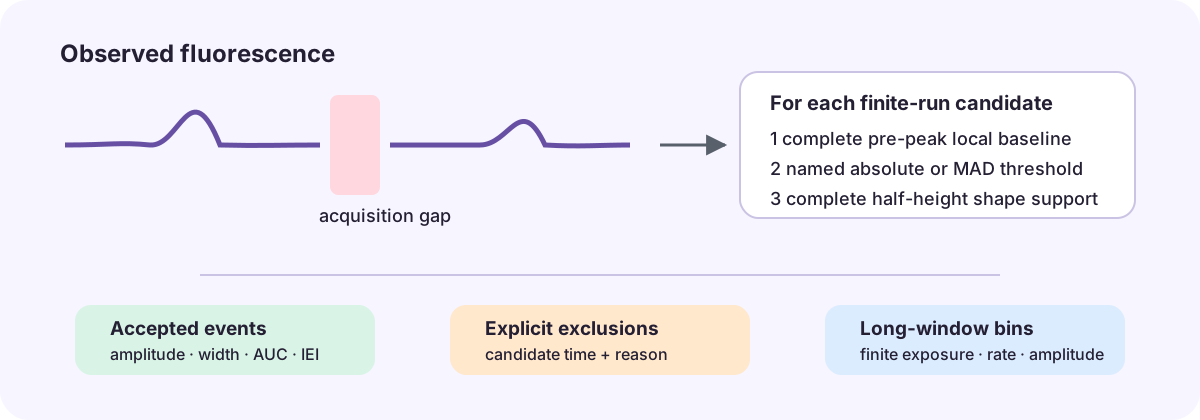
Simulate known events and a gap
import numpy as np

from fiberphotometry import (
    TransientDetectionSpec,
    detect_transients,
    make_recording,
)

rng = np.random.default_rng(4)
time = np.arange(0, 120, 0.02)
signal = rng.normal(0, 0.02, len(time))
for peak_time, amplitude, width in [
    (20, 0.5, 0.18),
    (52, 0.9, 0.25),
    (91, 0.7, 0.15),
]:
    signal += amplitude * np.exp(-0.5 * ((time - peak_time) / width) ** 2)

# A real acquisition interruption, not a region to interpolate for event finding.
signal[(time >= 59) & (time < 69)] = np.nan
recording = make_recording(
    time=time,
    signal=signal,
    channel_names=["green"],
    subject="simulation",
    session="known-events",
)
Run named alternatives
universes = {
    "rolling-3mad-median": TransientDetectionSpec(
        threshold_mode="rolling_mad",
        threshold=3,
        baseline_statistic="median",
    ),
    "rolling-5mad-median": TransientDetectionSpec(
        threshold_mode="rolling_mad",
        threshold=5,
        baseline_statistic="median",
    ),
    "global-3mad-minimum": TransientDetectionSpec(
        threshold_mode="global_mad",
        threshold=3,
        baseline_statistic="minimum",
    ),
}
results = {
    name: detect_transients(recording, variable="signal", spec=spec)
    for name, spec in universes.items()
}
For each universe, inspect both result.events and result.exclusions. Compare
the count and rate first, then ask whether the scientific conclusion survives
changes in amplitude, width, and AUC. A minimum baseline often increases measured
amplitude relative to a median baseline; that is a method consequence, not a new
biological observation.
for name, result in results.items():
    summary = result.summaries[0]
    print(name, summary.count, summary.rate_per_minute)
What this establishes—and what it does not
The executable regression fixtures recover a known Gaussian peak width, verify that a shape truncated by a gap is excluded, compare named baseline alternatives, and exercise rolling-MAD rejection. This is implementation ground truth. It is not yet biological validation across sensors, preparations, or human annotations.
The 30-second bins are useful for plotting how event rate changes through a long session. They remain descriptive transient summaries. Do not relabel them as tonic neurotransmitter concentration without an independently justified model.
The first public-data pass is now complete. Read the DANDI:000251 retained result: the universes disagree strongly, and only three of eight show enrichment in the pre-existing post-teleport response window. Because those files contain archived dF/F rather than raw reference channels, raw-preprocessing and manual-annotation validation remain open.