Auditable interval and bout policies
External behavior tools discover or annotate bouts. FiberPhotometry should not repeat that discovery, but scientists still need to state which bouts enter a neural analysis and how adjacent, long, contextual, or overlapping bouts are treated.
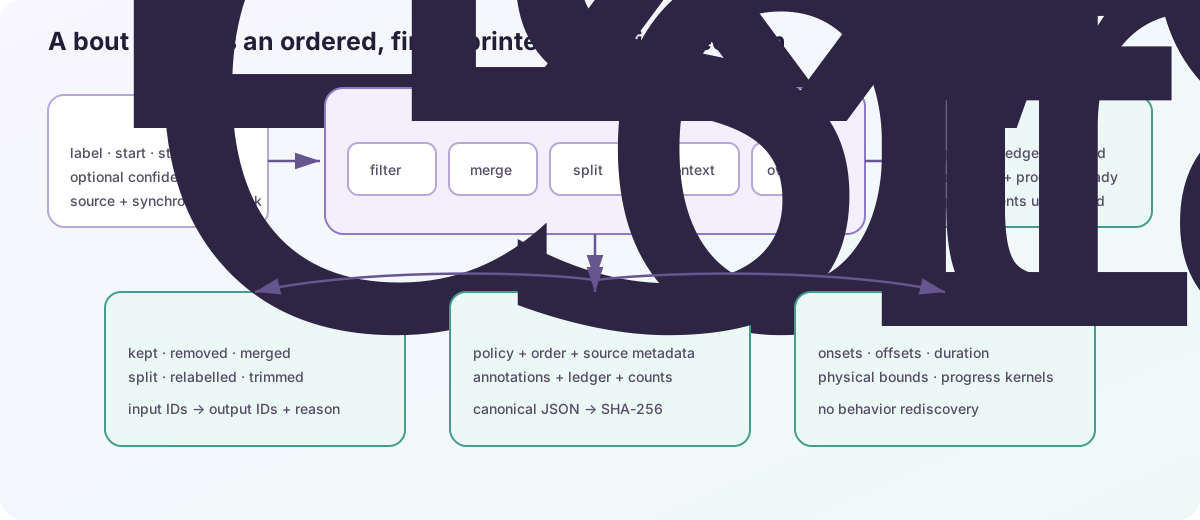
The boundary
DeepLabCut, SLEAP, Keypoint-MoSeq, BORIS, or another upstream system decides what
the behavior annotation means. apply_interval_policy() starts from synchronized
BehaviorAnnotations; it never examines video, pose, or photometry to choose a
rule. Point events are carried through unchanged.
| Operation | Declared decision | Important refusal or evidence |
|---|---|---|
FilterIntervals |
labels, duration bounds, confidence floor | missing confidence fails a declared floor |
MergeIntervals |
same-label maximum gap and confidence aggregation | no cross-label semantic merging |
SplitIntervals |
physical cut points and/or maximum segment duration | no data-dependent boundary discovery |
ContextualizeIntervals |
overlap source, overlap fraction, multi-match rule, label template | subject/session and clocks must match |
ResolveIntervalOverlaps |
scope and reject-or-priority rule | rejection names conflicts; priority retains trimmed lineage |
Define an ordered policy
from fiberphotometry import (
    ContextualizeIntervals,
    FilterIntervals,
    IntervalPolicy,
    MergeIntervals,
    ResolveIntervalOverlaps,
    apply_interval_policy,
)

policy = IntervalPolicy(
    (
        MergeIntervals(
            "merge-short-groom-gaps",
            labels=("groom",),
            maximum_gap_s=0.15,
        ),
        FilterIntervals("minimum-bout", minimum_duration_s=0.5),
        ContextualizeIntervals(
            "task-context",
            context_source="task-epochs",
            minimum_overlap_fraction=0.5,
            multiple_matches="first",
        ),
        ResolveIntervalOverlaps(
            "exclusive-state",
            scope="all",
            strategy="priority",
            label_priority=("groom@test", "locomotion@test"),
        ),
    )
)

result = apply_interval_policy(
    synchronized_bouts,
    policy,
    context_sources={"task-epochs": synchronized_task_epochs},
)
The tuple is executed exactly in the order written. Merging two short bouts can make their combined interval pass a minimum-duration filter; filtering first can remove both. Neither order is universally correct, so FiberPhotometry does not reorder or optimize the operations.
Inspect the evidence before fitting
print(result.input_interval_count, result.output_interval_count)
for row in result.ledger:
    print(row.operation_id, row.action, row.reason)

artifact = result.to_dict()  # JSON serializable
print(result.evidence_fingerprint)
Each ledger row contains immutable input and output snapshots. Contextual relabelling
rows also contain the precise overlapping context snapshots. Output snapshots retain
source_interval_ids, including all contributors to a merge and the common parent
of split or trimmed pieces. Kept and removed decisions are present too, so the
ledger records denominators rather than only successful transformations.
Store the complete dictionary beside the analysis configuration. The SHA-256 fingerprint covers the policy, transformed annotations, complete named context annotations, ledger, source metadata, clock synchronization IDs, and counts. A changed operation order, threshold, or context artifact therefore changes the evidence identity.
Context labels remain supplied evidence
ContextualizeIntervals accepts a named BehaviorAnnotations source such as task
epochs, stimulation states, sleep stages, or manual context annotations. Positive
physical overlap is required. minimum_overlap_fraction is measured relative to
the target bout, not the context interval.
Choose the multi-match meaning explicitly:
duplicatecreates one labelled copy per distinct qualifying context;firstusescontext_labelsas an explicit priority and then lexical order; orrejectstops when a bout matches more than one context.
Use keep_unmatched=False only when excluding out-of-context bouts is part of the
prospective analysis. The exclusion will remain in the ledger.
Overlap policies
scope="same_label" addresses repeated annotations of one state while leaving
co-occurring behaviors intact. scope="all" declares mutually exclusive states.
The default strategy="reject" is safest when overlap has no prespecified meaning.
With strategy="priority", labels earlier in label_priority take precedence.
Higher-priority physical spans are subtracted from later intervals. A lower-priority
bout can therefore be trimmed, split into multiple pieces, or removed. Equal and
unlisted priorities resolve by physical start, stop, label, and stable interval ID;
declare all meaningful priorities rather than relying on that deterministic tie-break.
Continue into photometry models
The result uses the existing annotation contract, so no conversion layer is needed:
inputs = result.annotations.interval_encoding_inputs(edge="onset")

session = EncodingSession.from_arrays(
    subject="mouse-1",
    session="day-1",
    time=photometry_time,
    response=processed_signal,
    events=inputs.events,
    event_values=inputs.event_values,
    intervals=inputs.intervals,
)
This supplies physical edges, duration modulation, and normalized-progress kernels
without turning policy decisions into behavior discovery. See the complete
examples/interval_policy.py
and the behavior-tool interoperability tutorial.
Current limits
The policy is session-local and interval-based. It does not infer bouts from probabilities, reconcile annotators statistically, select thresholds from neural outcomes, or fit longitudinal behavior. Keep probabilistic state inference and identity QC upstream; pass declared neural summaries to Unspool only after across-session comparability checks.