Public-data evidence atlas
These figures are not a gallery of idealized outputs. Each is generated from a versioned analysis of public photometry data and paired with the question it can answer, its experimental unit, and the limitation that controls interpretation.
Are event contrasts robust to reasonable preprocessing choices?
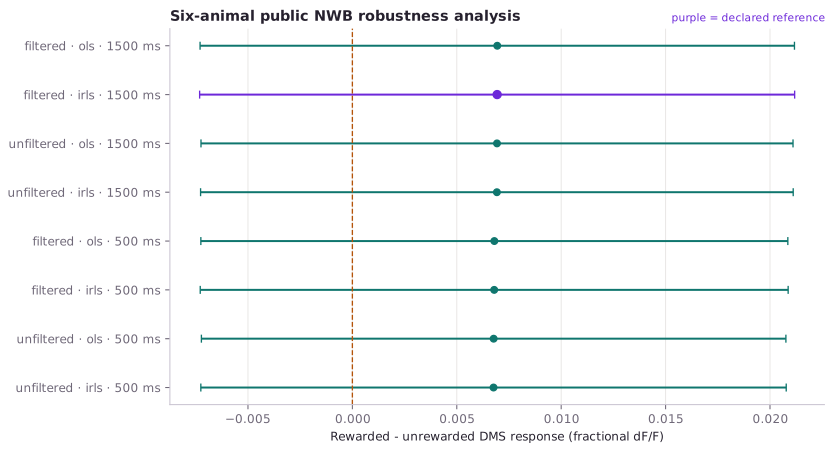
- Public source: DANDI:000971, from Seiler et al. (2022).
- Estimand: within-animal rewarded minus unrewarded DMS response.
- Independent units: six animals; events are not treated as replicates.
- Use it to learn: reference correction and response windows as named analysis decisions.
- Do not conclude: phenotype prevalence, source-study replication, or evidence for a nonzero population effect.
Run the raw-NWB tutorial or read the frozen result.
Does a descriptive contrast survive a wider signal-only multiverse?
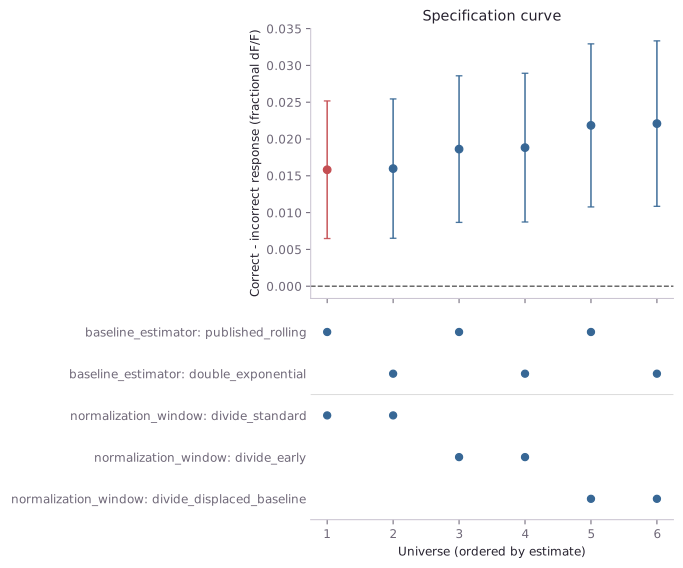
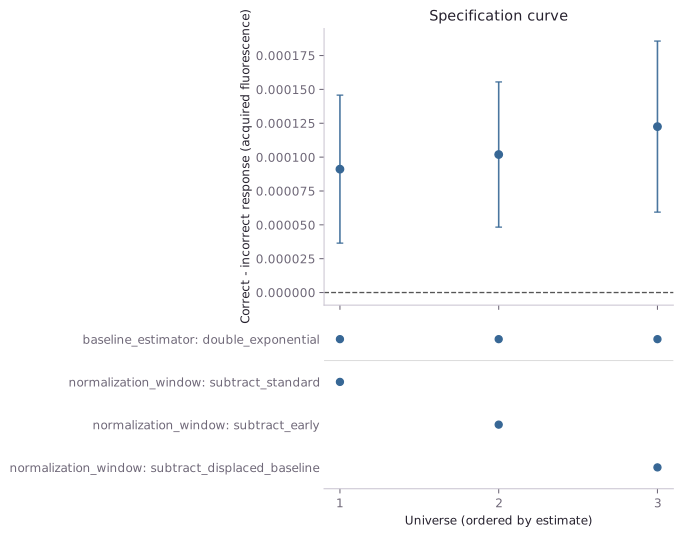
- Public source: 383 IBL sessions from 18 animals associated with Bimbard et al. (2024).
- Estimand: correct minus incorrect feedback response, with sessions weighted equally within animal.
- Independent units: 18 animals; 224,272 events contribute within the hierarchy.
- Use it to learn: compatible universes, structurally rejected workflows, separate unit lanes, and leave-one-animal-out diagnostics.
- Do not conclude: causal effects of correctness or robustness to untested preprocessing families.
Read the complete frozen result and amendments.
Can overlapping behavioral events predict a new animal?
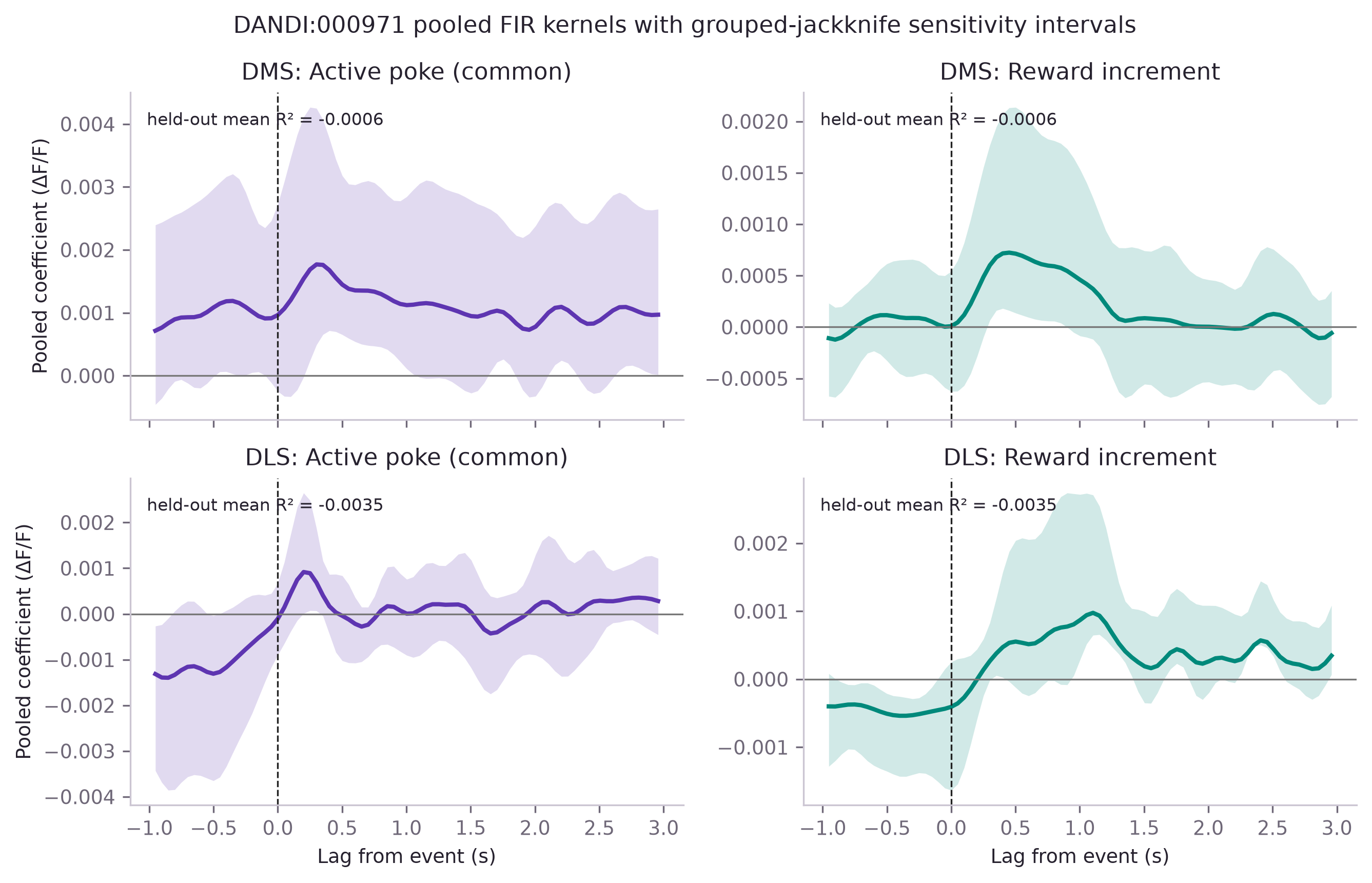
- Public source: the same checksum-pinned DANDI:000971 cohort.
- Estimand: active-poke kernel plus the conditional reward increment in continuous DMS and DLS signals.
- Validation unit: complete held-out animals, not samples from animals used in fitting.
- Use it to learn: overlapping-event design matrices, grouped penalty selection, residual diagnostics, and honest negative validation.
- Do not conclude: significant time points, regional differences, or useful out-of-animal prediction.
Read and reproduce the event-kernel analysis.
Does a previous-session neural summary improve behavioral forecasting?
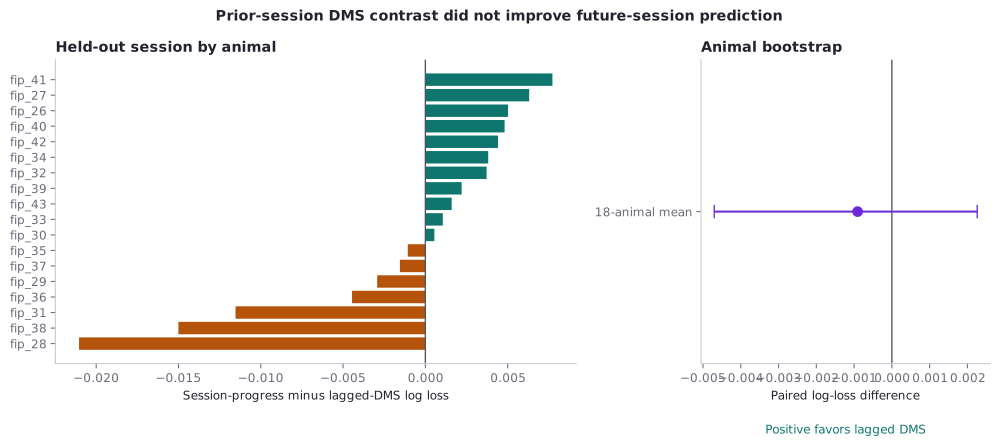
- Public source: 216 checksum-verified sessions from the 18-animal IBL cohort.
- Question: incremental prediction of correctness in one future session.
- Validation unit: a common held-out session within each animal; scoring and bootstrap are animal-balanced.
- Use it to learn: the FiberPhotometry-to-Unspool handoff, lagged predictors, and retained negative forecasts.
- Do not conclude: that DMS dopamine is unrelated to learning or that alternative neural summaries would fail.
Read the longitudinal neural–behavioral forecast.
How to read this atlas
An empirical figure earns a place here only when its page names the source data, experimental unit, estimand, preprocessing contract, inferential boundary, and a machine-readable result. Attractive output without those six items remains an illustration rather than scientific evidence.