Multiverse scientific contract v0.1
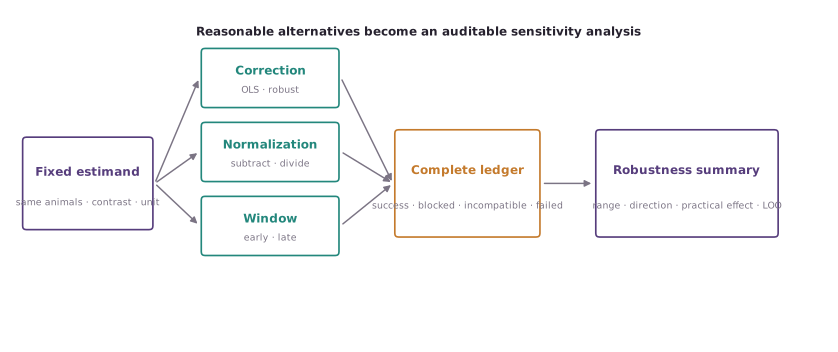
A FiberPhotometry multiverse evaluates multiple defensible workflows for one fixed dataset, scientific estimand, and experimental-unit declaration. It is a robustness analysis, not a search over outcomes or a substitute for replication.
Invariants
- Every universe has the same
Estimand, including outcome meaning, contrast, and aggregation unit. Changing the estimand creates a different multiverse. - Decision nodes and their alternatives have stable names and scientific rationales. Confirmatory nodes are frozen before inspecting final contrasts.
- A named reference selection is required; it is not silently treated as the uniquely correct workflow.
- Compatibility rules exclude incoherent combinations before execution and retain the exclusion reason.
- Project rules identify choices by node and alternative, must refer to existing alternatives, and may not exclude the named reference workflow.
- Method-specific preprocessing parameters are range-checked and serialized in each materialized pipeline; irrelevant parameters are rejected, not ignored.
- Every valid universe receives an identifier derived from its canonical choices and complete materialized pipeline specification.
- Successful, QC-blocked, incompatible, non-finite, and failed universes are all retained. Execution failure cannot improve the reported robustness fraction.
- Random seeds remain part of the materialized analysis plan.
- Coupled preprocessing/output choices are atomic: selecting subtractive normalization also selects its acquired-fluorescence event-summary variable.
- Estimates with different units occupy separate report lanes and never share a displayed range or median. One practical-effect threshold cannot span units.
Interpretation
Primary summaries concern estimates: range, median, direction, practical-effect stability, the reference estimate, and which choices shift the median estimate. The fraction of nominally significant results is not a primary robustness measure because universes are dependent specifications, not random independent samples.
When requested and structurally possible, leave-one-aggregation-unit-out results are computed for the declared reference universe. They diagnose dependence on a single animal or other population unit; they do not repair a small sample.
An exploratory multiverse may help identify influential decisions, but must not be relabelled confirmatory. Any revised decision space should receive a new specification and be validated on independent data.
Methodological context
This contract adapts multiverse analysis and specification-curve principles to nested photometry workflows:
- Steegen et al. (2016), Increasing Transparency Through a Multiverse Analysis.
- Simonsohn et al. (2020), Specification Curve Analysis.
- Carp (2012), On the Plurality of (Methodological) Worlds.
- Botvinik-Nezer et al. (2020), Variability in the Analysis of a Single Neuroimaging Dataset by Many Teams.