Public IBL neural–behavioral forecast
Retained negative predictive result
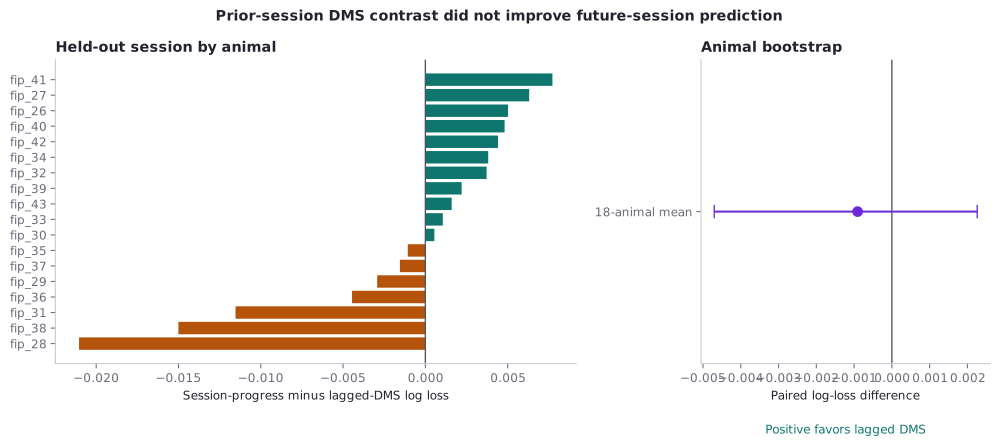
The prior session's DMS feedback contrast did not improve prediction in the held-out future session. The workflow remains valuable because that result was generated under a content-hashed protocol and is not replaced by a more favorable lag, window, or model.
Scientific question
Does the immediately previous session's DMS correct-minus-incorrect feedback response improve prediction of trial correctness in one future session, beyond a stationary behavioral model and linear session progress?
The 18-animal public cohort accompanies the longitudinal visual-learning study by Pan-Vazquez, Sanchez Araujo et al. (2024). The source paper used richer behavioral and neural encoding models. This benchmark is a narrower product test, not a reproduction of its principal claims.
Why two packages?
FiberPhotometry loads the 470-nm-only recordings, verifies source checksums, applies the previously declared rolling divided-dF/F workflow, and calculates one feedback contrast per session. Its validated handoff retains every trial and attaches the previous session's neural summary.
Unspool then owns the explicit session clock, within-session correctness history, cohort-forward split, model fits, audits, animal-balanced scoring, and paired animal bootstrap. No behavioral trajectory engine is duplicated inside FiberPhotometry.
Frozen design
- Animals: 18.
- Source sessions accessed: 216; orders 0–11 for every animal.
- Training rows: 95,717 events from session orders 1–10.
- Held-out rows: 11,919 events from order 11.
- Neural predictor: order t−1 DMS correct-minus-incorrect feedback response, divided by a fixed 0.01 fractional-dF/F scale.
- Candidates: stationary; linear session progress; session progress plus lagged DMS contrast.
- Primary metric: equally animal-weighted future-session log loss.
- Uncertainty: 5,000 paired animal-bootstrap draws, seed
20260727.
Read the frozen protocol before interpreting the result.
Result
| Candidate | Animal-balanced log loss | Pooled log loss | Fit audit |
|---|---|---|---|
| Session progress | 0.64316 | 0.63434 | pass |
| Session progress + lagged DMS | 0.64407 | 0.63518 | pass |
| Stationary | 0.65437 | 0.64965 | pass |
The session-progress model had the lowest future-session log loss. Adding lagged DMS
worsened animal-balanced log loss by 0.000907 on average. Only 31.82% of paired
animal-bootstrap draws favored the neural model. Session progress improved the point
estimate relative to the stationary model, but its own paired interval also crossed
zero; this one fold is not enough to claim a general learning-curve advantage.
Interpretation
This does not imply that DMS dopamine is unrelated to learning. The source paper's neural quantities were side-, contrast-, region-, and kernel-specific; our predictor is a coarse feedback contrast from a signal-only preprocessing lane. A one-session lag may also miss the relevant temporal relationship.
Those are reasons to design new frozen alternatives, not permission to search this same held-out session. The current result establishes that the first simple bridge works end to end and that this particular neural summary does not add predictive value under the declared test.
Reproduce it
With the cached IBL data and both repositories available:
uv run --group ibl-validation \
  --with "unspool @ git+https://github.com/aeronjl/unspool@1fca711574c3968cc5ff5b8609c6e40dbe99bf6c" \
  python scripts/run_ibl_unspool_longitudinal_v1.py
The committed machine-readable result retains all source hashes, session neural summaries, the handoff fingerprint, exact fold membership, model signatures, fit audits, animal-level scores, bootstrap intervals, package versions, and the final result hash.