Ask whether a predictor family improves held-out prediction
Experimental predictive sensitivity
A full-versus-reduced score difference is not a causal effect, unique variance, model-free importance, or proof that a neural signal represents the omitted variable. It is conditional on two declared models and their validation data.
Scientific question
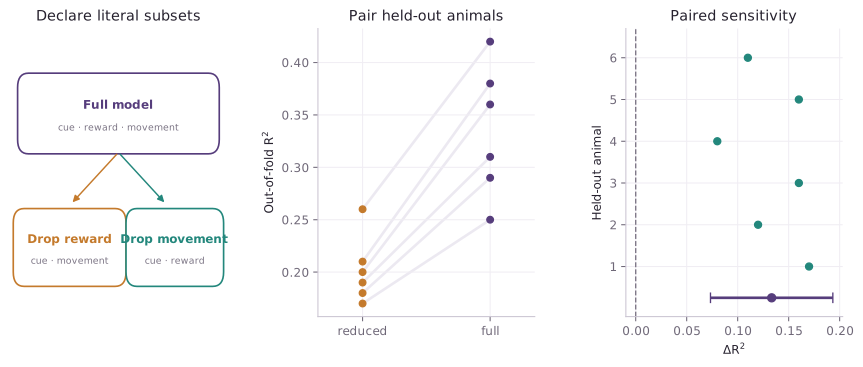
Given a defensible full encoding model, does one prespecified family—events, movement, trial history, or normalized progress—improve prediction of observations from animals or sessions that were not used to fit that fold?
Recent photometry work has used cross-validated leave-predictor-out analyses to ask this kind of conditional predictive question—for example, Touponse et al. (2025) combine lagged behavioral kernels, cross-validation, and leave-predictor-out analysis. The package implements the comparison as a strict layer over an existing encoding multiverse, because silently rebuilding models would sever the result from its declared alternatives and failure ledger. See the motivating literature synthesis in the capability audit.
Declare literal drops
from fiberphotometry import (
    PredictorFamilyContributionSpec,
    PredictorFamilyDropSpec,
    assess_predictor_family_contributions,
)

contribution_spec = PredictorFamilyContributionSpec(
    full_model="cue-reward-motion",
    families=(
        PredictorFamilyDropSpec(
            family="movement",
            reduced_model="cue-and-reward",
            removed_predictors=("motion",),
            rationale="Ask whether movement improves held-out prediction.",
        ),
        PredictorFamilyDropSpec(
            family="reward events",
            reduced_model="cue-motion",
            removed_predictors=("reward",),
            rationale="Ask whether reward timing improves held-out prediction.",
        ),
    ),
)

result = assess_predictor_family_contributions(multiverse_result, contribution_spec)
The caller names the full model, reduced model, scientific family, exact predictor names expected to disappear, and rationale. The package verifies that each reduced model is a literal subset of the full model. It rejects:
- a changed lag window, basis, modulation, or source under a shared predictor name;
- predictors added only to the nominally reduced model;
- a changed ridge grid, grouping, fold count, sampling tolerance, or coverage rule;
- an inaccurate list of removed predictors; and
- a model name absent from the retained multiverse ledger.
This is deliberately stricter than the general multiverse, where changing several modeling choices can be scientifically legitimate. A family-drop label is only honest when the named family is the complete computational difference.
Common evidence and paired groups
Both fits must retain the same timestamp fingerprints. If a movement-confidence
mask removes rows only from the full model, both model scores remain visible but
the comparison becomes descriptive_only; no delta or interval is emitted.
For eligible comparisons, the primary value is
using each model's selected ridge penalty and mean cross-validation score. Positive values favour the full model predictively. The artifact also pairs out-of-fold \(R^2\) within each held-out animal or session, retaining group identities and observation counts.
The reported Student-t interval is calculated across those paired group deltas.
It is labelled paired_group_t_sensitivity, is not simultaneous across families,
and is conditional on the declared models, selected penalties, grouping, and
available groups. With few animals or heterogeneous group scores it can be wide or
unstable; inspect the complete group_deltas rather than reducing the result to
whether the interval crosses zero.
Read the result without overclaiming
| Result | Defensible interpretation | Not supported |
|---|---|---|
| Positive delta | The full specification transported better to held-out groups | The predictor caused or is uniquely encoded by the fluorescence |
| Near-zero delta | The family added little held-out score under these paired specifications | The biological variable is irrelevant |
| Negative delta | The reduced model transported better under this validation | The family suppresses the neural signal |
| Descriptive only | Denominators differ; inspect both fits separately | A numerical family contribution |
| Failed | A declared full or reduced model could not be fitted | Removing the failed model from the analysis set |
Correlated families can substitute for one another, and their leave-one-family-out deltas do not add to total model performance. Comparing many families after seeing the outcome is exploratory multiplicity, not confirmatory discovery. A useful workflow prespecifies a small set of scientifically coherent families, reports all failures and group deltas, and tests any resulting hypothesis in new data.
Run the worked simulation
The seeded eight-animal example writes both
event-kernel-multiverse-result.json and
predictor-family-contribution-result.json. The latter retains the declaration,
stable full/reduced universe IDs, selected penalties and scores, paired animal
deltas, conditional interval, eligibility status, and failure or comparison reason.
The comparison boundary is governed by SDR-0039.