Optogenetic artifacts and sensor validity
For an independently calibrated linear model that separates declared sensor, hemodynamic, background, or spectral contributions, see wavelength-aware optical unmixing. A numerically identifiable matrix complements rather than replaces the validity checks below.
Optical experiments need two safeguards that answer different questions:
- Which samples were prospectively excluded because stimulation occurred?
- Does the recorded optical evidence support the intended interpretation?
FiberPhotometry keeps those questions separate. A pulse-derived mask cannot expand or shrink after the signal is inspected, while recovery, saturation, wavelength, and reference-channel diagnostics remain visible evidence alongside the analysis.
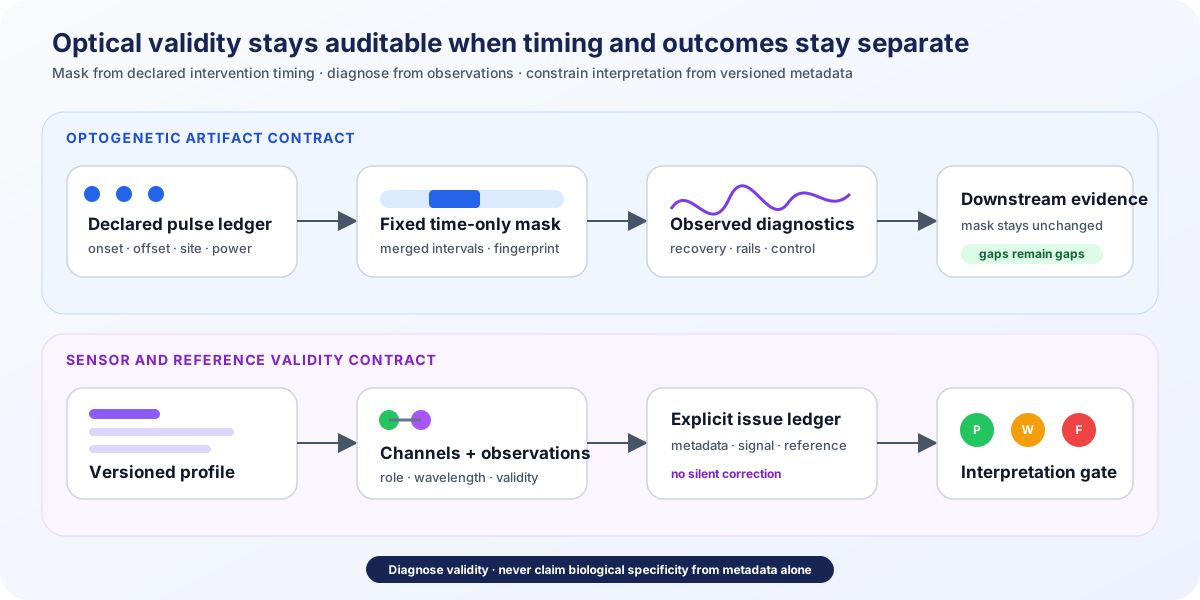
Both APIs are experimental. They provide operational safeguards and provenance, not automatic artifact correction, hemodynamic correction, spectral unmixing, deconvolution, or concentration calibration.
Build a prospective stimulation mask
Declare pulses in the same clock as the photometry samples, then choose the fixed pre/post exclusion policy before inspecting outcomes:
from fiberphotometry import (
    OptogeneticMaskSpec,
    StimulationPulse,
    build_optogenetic_artifact_mask,
)

pulses = (
    StimulationPulse(
        pulse_id="train-001",
        onset_s=42.0,
        offset_s=42.5,
        site="VTA",
        wavelength_nm=473,
        power_mw=5,
    ),
)

mask = build_optogenetic_artifact_mask(
    recording.time,
    pulses,
    OptogeneticMaskSpec(pre_pulse_s=0.01, post_pulse_s=0.20),
    existing_valid=recording.valid,
)
The result retains the complete pulse ledger, merged exclusion intervals, original and newly invalid sample counts, the retained denominator, and a deterministic fingerprint. Overlapping expanded pulse intervals are merged without losing their pulse IDs. Existing invalidity is composed with the artifact mask; timestamps are never compressed.
mask.valid_array can be passed directly to downstream APIs that accept a valid
mask, including welch_psd, spectrogram, and the paired-signal functions. This
means an optogenetic exclusion becomes an ordinary continuity boundary: spectral
windows, lag pairs, and state summaries cannot bridge it.
Diagnose recovery without changing the mask
Observed recovery is useful, but allowing it to determine the exclusion would make the analyzed denominator depend on the outcome. Run it as a separate assessment:
from fiberphotometry import (
    OptogeneticRecoverySpec,
    assess_optogenetic_artifacts,
)

assessment = assess_optogenetic_artifacts(
    recording.time,
    recording.signal,
    pulses,
    OptogeneticRecoverySpec(
        baseline_duration_s=0.5,
        assessment_duration_s=1.0,
        recovery_threshold_sd=3.0,
        stable_duration_s=0.05,
        detector_floor=-1.0,
        detector_ceiling=1.0,
    ),
    valid=recording.valid,
    negative_control=fluorophore_negative_control,
    negative_control_name="fluorophore-negative-control",
)
For every pulse the assessment records robust baseline location/scale, peak deviation, recovery time, required stable-sample count, detector saturation, and optional negative-control behavior. Closely spaced pulses explicitly censor the first recovery window and flag a subsequent contaminated baseline. Important warnings include:
recovery_censored_by_next_pulse;baseline_overlaps_previous_pulse;not_recovered_in_window;detector_saturation_during_assessment; andlarge_negative_control_artifact.
These observations may justify a new prospective mask specification in a later study or sensitivity universe. They never mutate the current mask.
Declare a versioned sensor profile
Sensor metadata evolves, varies by construct and preparation, and is often context-specific. The package therefore provides an open registry rather than a closed enum or a silently updated table of built-in sensor facts.
from fiberphotometry import (
    SensorKinetics,
    SensorProfile,
    SensorRegistry,
    WavelengthRange,
)

profile = SensorProfile(
    profile_id="my-lab-dlight13b",
    sensor_name="dLight1.3b",
    profile_version="2026-07-27",
    signal_excitation_nm=WavelengthRange(465, 475),
    emission_nm=WavelengthRange(510, 540),
    isosbestic_excitation_nm=WavelengthRange(405, 415),
    interpretation="reports fluorescence change, not dopamine concentration",
    evidence_source="DOI, protocol version, or lab calibration record",
    kinetics=SensorKinetics(
        rise_time_s=0.05,
        decay_time_s=0.40,
        measurement_context="bench characterization",
        evidence_source="DOI or calibration record",
    ),
    linear_response_range=(-3.0, 3.0),
    linear_response_unit="dF/F",
    constraints=("do not infer sub-50-ms dynamics",),
    metadata=(("construct", "dLight1.3b"),),
)

registry = SensorRegistry().with_profile(profile)
profile = registry.resolve("my-lab-dlight13b", "2026-07-27")
Every profile version is immutable. If a registry contains multiple versions, resolution without an explicit version fails instead of selecting the newest one. New evidence should create a new profile version; old analyses retain their original interpretation contract.
Assess the recorded channels
Pair the profile with explicit channel identity and preprocessing provenance:
from fiberphotometry import (
    ChannelIdentity,
    SensorChannelAssignment,
    SensorValiditySpec,
    assess_sensor_validity,
)

signal_channel = ChannelIdentity(
    "dms-signal",
    "DMS",
    "dLight1.3b",
    "sensor",
    "dF/F",
    excitation_wavelength_nm=470,
    emission_wavelength_nm=525,
    detector_id="detector-1",
    fiber_id="fiber-1",
)
reference_channel = ChannelIdentity(
    "dms-reference",
    "DMS",
    "dLight1.3b",
    "isosbestic",
    "dF/F",
    excitation_wavelength_nm=410,
    emission_wavelength_nm=525,
    detector_id="detector-1",
    fiber_id="fiber-1",
)
assignment = SensorChannelAssignment(
    subject="mouse-01",
    session="session-01",
    signal=signal_channel,
    reference=reference_channel,
    clock_id="photometry-clock",
    alignment_policy="native_shared_clock",
    preprocessing_fingerprint="sha256:...",
)

validity = assess_sensor_validity(
    time,
    signal,
    assignment,
    profile,
    SensorValiditySpec(detector_floor=-1.0, detector_ceiling=1.0),
    reference_values=reference,
    signal_valid=signal_valid,
    reference_valid=reference_valid,
    event_times=events,
)
The assessment checks declared role, sensor, excitation/emission ranges, detector, fiber, units, finite support, repeated extrema, flat steps, saturation, and any declared linear range. With a reference channel it also reports shared valid support, signal/reference variance and correlation, derivative lag evidence, and event- correlated reference responses. Gap handling is inherited from the same continuity contract used by the spectral and multisignal APIs.
status is pass, warning, or fail; every non-pass state retains machine-
readable issue codes. require_ready() can enforce the result at an application
boundary. The JSON output retains the exact profile, assignment, thresholds,
metrics, issues, and interpretation constraints.
What the assessment cannot establish
A matching excitation range does not prove that a channel is isosbestic in vivo. A quiet reference does not prove absence of hemodynamics or movement. Correlation does not establish contamination, and kinetics measured in one preparation need not transfer to another. Detector rails must come from the acquisition system; package defaults cannot infer them from the observed extrema without circularity.
For those reasons this layer diagnoses validity and constrains interpretation. It does not automatically regress the reference, lengthen pulse masks, unmix spectra, or convert fluorescence to analyte concentration.
Current product boundary
| Available now | Still a deliberate gap |
|---|---|
| Fixed time-only pulse masks with fingerprints | Data-adaptive artifact-mask expansion |
| Pulse recovery, censoring, saturation, and negative-control evidence | Automatic optogenetic artifact interpolation or subtraction |
| Open, versioned sensor profiles | Package-maintained authoritative sensor database |
| Wavelength, detector, fiber, role, and unit checks | Wavelength-aware hemodynamic correction and spectral unmixing |
| Gap-aware isosbestic association, lag, and event diagnostics | Proof of biological inertness or concentration calibration |
| Pass/warning/fail gates with JSON provenance | Validated nonlinear or universal sensor deconvolution |
The separate experimental sensor-kinetic modeling workflow now supports versioned linear forward models and guarded regularized inversion. It consumes this layer's validity evidence but does not weaken the biological claim boundary.
See SDR-0047 for the decision boundary and the capability matrix for adjacent roadmap gaps.