Spontaneous transients and long recordings
Experimental method family
There is no field-wide spontaneous-event definition. Report the complete specification and show whether conclusions survive plausible alternatives.
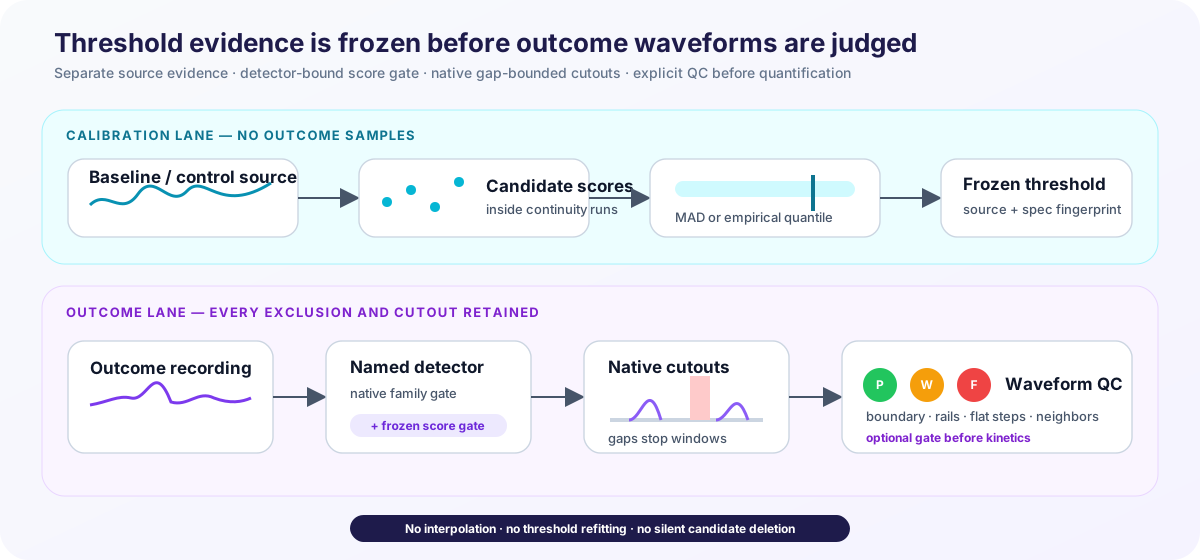
The preferred product API separates candidate detection from kinetic quantification. This matters whenever detection uses a normalized representation: candidate timestamps can come from a z-scored stream while amplitude, width, and area are measured on non-z-scored dF/F.
from fiberphotometry import (
    ProminenceTransientDetectorSpec,
    TransientQuantificationSpec,
    detect_transient_candidates,
    quantify_transient_candidates,
)

candidates = detect_transient_candidates(
    recording,
    variable="detection_z",
    spec=ProminenceTransientDetectorSpec(
        minimum_height_z=1,
        minimum_prominence_z=2,
        detrend_window_s=100,
    ),
)
result = quantify_transient_candidates(
    recording,
    candidates,
    variable="dff",
    spec=TransientQuantificationSpec(
        baseline_method="mean",
        baseline_start_s=1.0,
        baseline_end_s=0.2,
    ),
)
Both stages split the signal at missing acquisition and large timestamp gaps. Candidate IDs retain the detector family, sample, threshold, and score through quantification.
Freeze a threshold from baseline or control evidence
Threshold calibration consumes a separate recording containing explicitly designated baseline or negative-control evidence. It extracts candidate-scale peak scores inside uninterrupted runs and produces an immutable threshold for every channel:
from fiberphotometry import (
    ProminenceTransientDetectorSpec,
    TransientThresholdCalibrationSpec,
    calibrate_transient_thresholds,
)

detector_spec = ProminenceTransientDetectorSpec(
    minimum_height_z=1,
    minimum_prominence_z=2,
    detrend_window_s=100,
)
frozen = calibrate_transient_thresholds(
    negative_control_recording,
    variable="detection_z",
    detector_spec=detector_spec,
    source_role="negative_control",
    source_id="fluorophore-negative-control-01",
    preprocessing_fingerprint="sha256:...",
    calibration_spec=TransientThresholdCalibrationSpec(
        estimator="empirical_quantile",
        quantile=0.999,
        minimum_score_count=100,
    ),
)

candidates = detect_transient_candidates(
    outcome_recording,
    variable="detection_z",
    spec=detector_spec,
    frozen_thresholds=frozen,
)
The frozen object binds the thresholds to the exact detector dataclass, detector variable, ordered channels, source role and ID, preprocessing fingerprint, estimator, and calibration denominator. Reusing it with a changed detector specification, variable, or channel layout fails. The calibration fingerprint changes if source samples or any part of that contract changes.
Two estimators are explicit alternatives:
median_maduses the median candidate score plus a declared robust-MAD multiplier;empirical_quantileuses a declared quantile of the source score distribution.
PASTa and GuPPY candidate scores are amplitudes above their family-specific
baselines; prominence-family scores are gap-local z-scale prominences. The frozen
value is an additional score gate. Each family's native threshold still applies,
and sub-threshold local maxima remain in exclusions with observed and required
scores. Calibration does not decide which estimator or source is scientifically
correct; those belong in the prospective analysis specification and robustness
workflow.
Cut and review candidate waveforms
Cutouts retain native samples and stop at missing acquisition, timestamp gaps, and recording boundaries. They are never interpolated onto a synthetic time grid:
from fiberphotometry import TransientWaveformSpec, cut_transient_waveforms

waveforms = cut_transient_waveforms(
    outcome_recording,
    candidates,
    variable="dff",
    spec=TransientWaveformSpec(
        pre_peak_s=1.0,
        post_peak_s=2.0,
        require_complete_window=True,
        detector_floor=-1.0,
        detector_ceiling=1.0,
    ),
)

result = quantify_transient_candidates(
    outcome_recording,
    candidates,
    variable="dff",
    spec=TransientQuantificationSpec(
        require_waveform_qc=True,
        allow_waveform_warnings=True,
    ),
    waveforms=waveforms,
)
Every candidate keeps its cutout even when QC fails. Each waveform reports requested
and observed bounds, pre/post coverage, baseline median/SD/slope, exact repeated-step
fraction, optional detector-rail fraction, nearby candidate IDs, issue codes, and a
pass, warning, or fail status. Default failures include incomplete required
windows, excessive detector saturation, and long repeated plateaus. A nearby event is
a warning because the cutout is not an isolated-event waveform.
waveforms.to_xarray() pads ragged native cutouts for plotting while retaining a
two-dimensional native relative-time array and presence mask; it does not interpolate.
When require_waveform_qc=True, failed candidates are retained as explicit
waveform_qc_failed quantification exclusions. Warning-bearing cutouts remain eligible
by default, or can be refused prospectively with allow_waveform_warnings=False.
Named detector families
PastaTransientDetectorSpecfinds local maxima and tests their amplitude relative to a pre-peak mean, minimum, or last local minimum. Its threshold is supplied in the same units as the detection stream.GuppyTransientDetectorSpecimplements GuPPY's chunked two-threshold procedure: high-amplitude samples are excluded using the first, unscaled MAD threshold before the second MAD threshold and local-maximum detection.ProminenceTransientDetectorSpecoptionally removes a gap-local moving mean, z-scores within each uninterrupted run, and requires both peak height and prominence. Quantification remains a separate call on dF/F.
These are compatibility families, not assertions that one detector is correct. The exact specification belongs in analysis provenance.
Legacy combined call
detect_transients() remains available for the earlier single-variable workflow:
from fiberphotometry import TransientDetectionSpec, detect_transients

result = detect_transients(
    recording,
    variable="dff",
    spec=TransientDetectionSpec(
        threshold_mode="rolling_mad",
        threshold=3.0,
        noise_window_s=15.0,
        baseline_duration_s=0.9,
        baseline_gap_s=0.1,
        baseline_statistic="median",
        minimum_distance_s=0.2,
        bin_width_s=30.0,
    ),
)
What the outputs mean
eventscontains peak time, local baseline, amplitude, half-height rise/fall timing and width, AUC, and preceding inter-event interval.exclusionsrecords insufficient baselines, sub-threshold candidates, and shapes truncated by acquisition boundaries or gaps.summariesreports count, rate, and median event properties per channel.binsprovides count, finite exposure, exposure-adjusted rate, and median amplitude in long windows.
The bins are descriptive. They are not called a tonic signal: slow fluorescence variation may combine biology with bleaching, motion, and sensor kinetics.
A minimum sensitivity analysis
At minimum, compare global_mad and rolling_mad, more than one defensible MAD
multiplier, and median versus minimum local baselines. The scientific result
should include changes in event count as well as downstream effect estimates.
For new work, prefer the separated calls. Do not use a z-scored quantification variable to claim interpretable changes in amplitude or kinetics across conditions.
Current boundaries
Quantification marks nearby events with compound-group/rank metadata, accepts frozen baseline/control score gates, and can require gap-aware waveform QC. These safeguards do not establish that detected fluorescence peaks are neurotransmitter-release events, choose a universally valid threshold source, deconvolve sensor kinetics, or resolve overlapping compound events into latent components.
See SDR-0048 for the decision boundary.
Animal-level rate and kinetic contrasts
Attach subject, session, and condition identity to each quantified result, then declare a paired or independent contrast:
from fiberphotometry import (
    TransientAnimalInferenceSpec,
    TransientStudySession,
    infer_transient_animals,
)

study = [
    TransientStudySession(
        subject="mouse-01",
        session="day-1",
        condition="control",
        result=control_result,
    ),
    TransientStudySession(
        subject="mouse-01",
        session="day-2",
        condition="drug",
        result=drug_result,
    ),
    # Additional animals...
]
inference = infer_transient_animals(
    study,
    TransientAnimalInferenceSpec(
        metric="rate_per_minute",  # or amplitude, width_s, auc
        condition_a="control",
        condition_b="drug",
        channel="NAc",
        design="paired",
        effect_scale="difference",
        seed=2026,
    ),
)
Rates pool event counts over acquired exposure within each animal-condition. Kinetic metrics are summarized within session and then within animal. Bootstrap intervals resample animals; permutation evidence swaps conditions within paired animals or shuffles whole-animal estimates in independent designs. The result retains every animal estimate and reports incomplete paired animals explicitly.
This API does not deconvolve sensor kinetics, assign events to neurotransmitter release episodes, or infer a biological tonic/phasic decomposition.
For the shared support, influence, simultaneous-band, and group-by-condition
contract, use materialize_transient_population() and then call .contrast() or
.interaction(). The cross-workflow population guide
shows the complete evidence boundary. The materializer retains zero-event rate
cells when analyzed exposure is positive.
Sources
- Donka et al., PASTa: flexible photometry analysis including spontaneous transients
- Sherathiya et al., GuPPy: a Python toolbox for fiber photometry analysis
- Wallace et al., The z-scored data are not the data
- Markowitz et al., Wideband dopamine dynamics